
 (4 / 5)
I’ve been haunted by the imagery of Romeo Castellucci all summer. This piercing director who has made art for decades, has made his way into opera and major theatres all over Europe, leaves a deeply lasting impression.
I was asked to stagger the review of Castellucci’s production Messiaen’s Saint François d’Assise in Salzburg. There is a vast quantity of things to break down in that opera production. Yet with his previous work Bros, which is back and in London next year, with several other stagings across Europe, now is the best time to encounter this true one off in theatre.
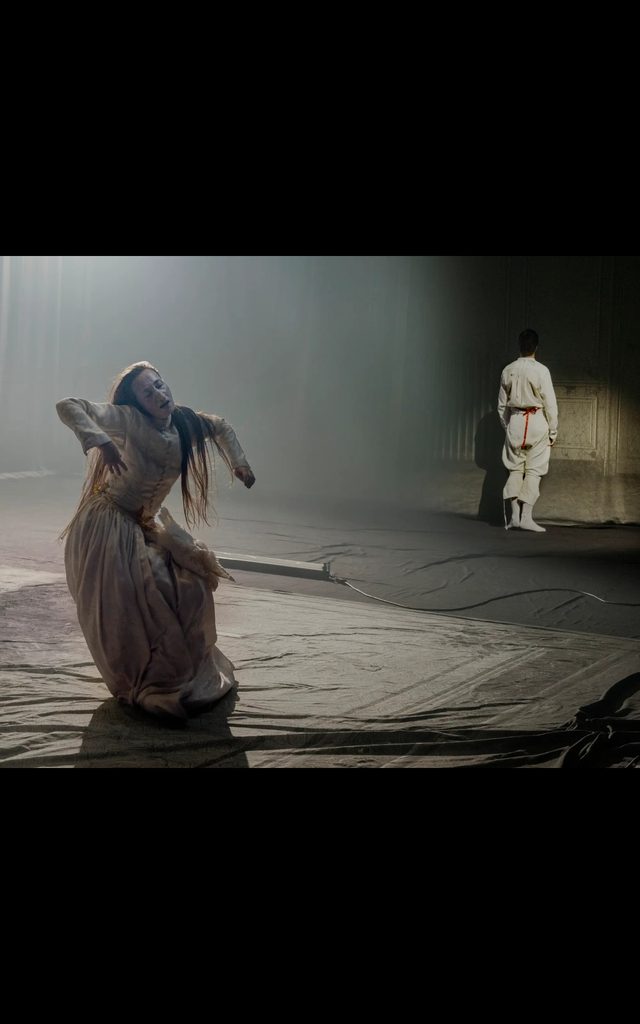
Photo credit: Alex Majoli
At present, Paris is in turmoil. I took risks being here, though I trudged through to make it to see this take on Faust. This is not directly Goethe, but rather representations of the characters through symbols and themes. Through this lack of narrative structure, we face performance art that remains bold and captivating. Castellucci’s depth of atmosphere is always unique and profound; his use of lighting and stage work is often captivating. We lost American maverick Robert Wilson last year and few artists could rival him, yet Castellucci often take risks. He is filled with the utmost invention in his stage craft.
Gérald Bayle is a form of Faust, who moans and writhes in his bed, his shoes set ablaze in soft flame. Often in his own world, he appears lost in his being even before his encounter with the essential evil. As this Mephistopheles, Lorenzo Coletta arrives on stage clambering about, aside the thumbing beats of Scott Gibbons. As he whips off bed mattresses, storming the space, above a mechanical arm gyrates a large glow stick for further effect. This is only the prelude of this Faust…
Stefania Horodeyska as Gretchen (who’s formal name is Margarete) appears to suffer the most. Through physical torments, she writhes and gestures feverishly upon her first visitation. This impact is immense as she struggles and strains in a long dress, featuring a flower upon her back. Many odd moments follow. A live dog is seen on stage, clearly following strick treat prompts around the stage, as another stuffed, grinning hound haunts the centre space. Faust bares mock pigeon disks for shooting, often aimed directly at his face and head. A robotic voice is also heard listing an assortment of writers, scholars, pop culture figures. Another contraption seemingly mimics the patter of applause and is even more disturbing in the process.
As a work of theatre, I found this highly effective on a few levels. We heard shell horns as a form of intermission, deep and moody in the sound and timbre. Horodeyska returns later, bare breasted, caked in white as a bizarre snapping device is placed in her mouth, as she appears to bleed from within. Coletta is caked in ashen dust in one instance, clogged in this state the rest of the show. An ode to Polish theatre practitioner Jerzy Grotowski is seen upon a miniature screen, as this small force of artists mimic the intense shouting and wailing heard in this other form of extreme theatre. Tubes appear with red liquid passing through the wings, the names of major newspaper publications are billed as if half printed on screens and spark plugs also charge. The Parisian icon of a grey Winged Victory is another headless ghost in this plateau. Who on earth could think of all this but Castellucci?
These three artists almost had a refusal of a bow at the curtain; performance art often tends to lack a jolly ovation from those in it. Yet this was profoundly moving and also completely absurd. Norm MacDonald said it best: “”What an odd duck!”
Faust: Fait, non-Dit counties till 27th November 2026.