
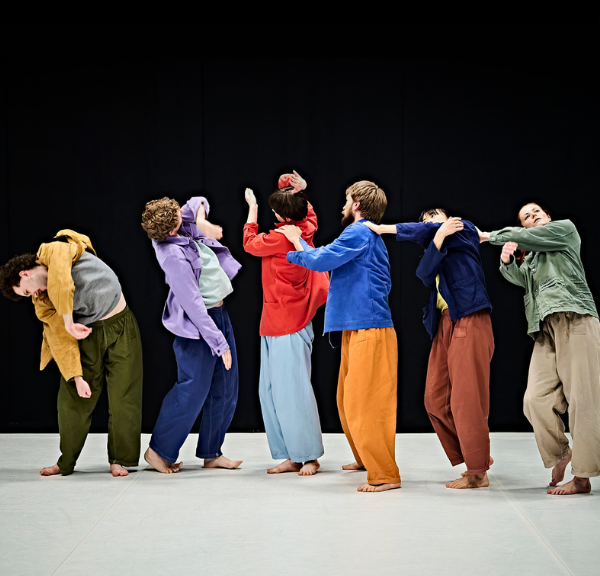
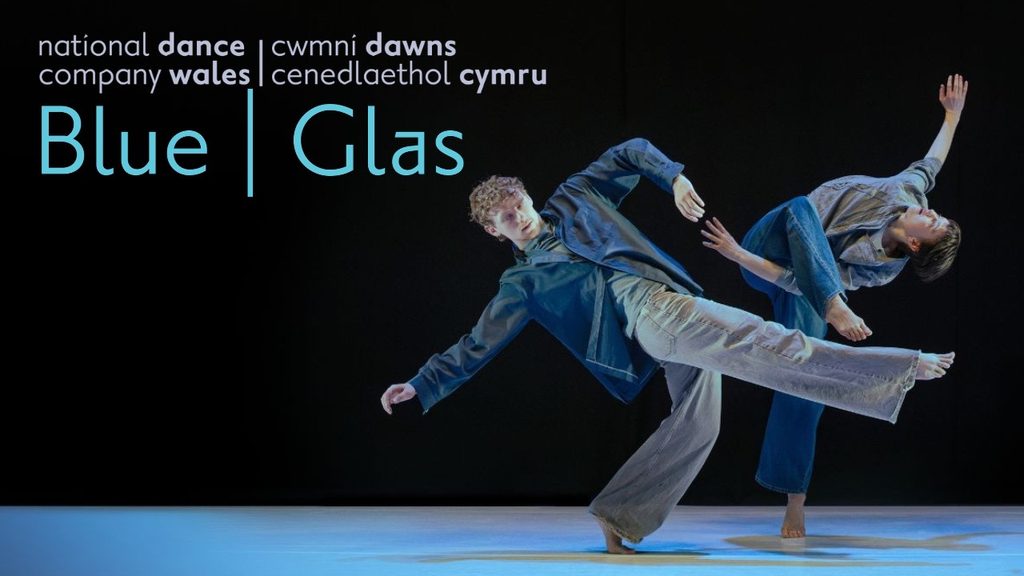
‘Blue/Glas’ consists of two pieces – Ordinary Courage and then Untamed. Each piece is danced by six dancers – three women and three men. Ordinary Courage, choreographed by Theo Clinkard and originally created in 2012, lasts about fifty minutes. Untamed, choreographed by Alesandra Seutin, lasts about twenty minutes.
The programme informs us that Ordinary Courage was created following the death of Theo Clinkard’s mother, so it is rooted in grief. I’m not sure that this is entirely relevant. I’m a long way away from being any kind of expert on dance but I think contemporary dance as an art form is quite abstract. Up to a point it allows you to make out of a performance what you want, to take away what you see and experience. Ordinary Courage is sensitively detailed and impassioned and it covers a wide range of moods, but I wouldn’t have associated it with grief or bereavement if I hadn’t read the programme notes. It’s so very lively that it made me think of a primary school children’s playground at playtime, without the shrill sound of voices.
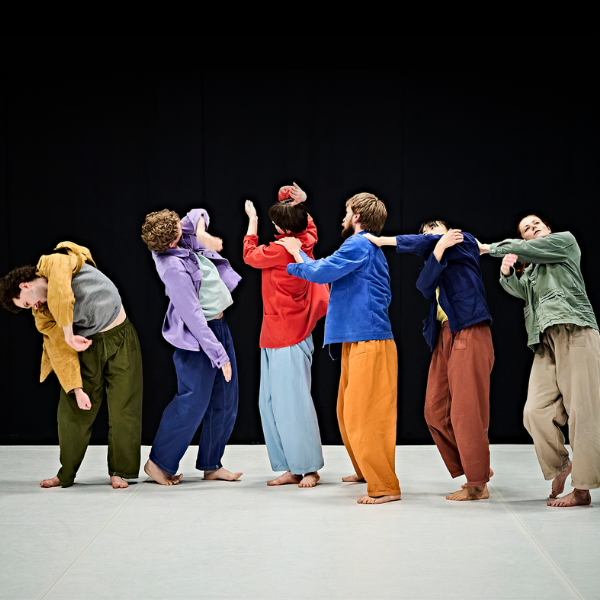
The performers in Ordinary Courage are casually dressed in the kind of almost washed-out clothing that is ‘comfortable’ for workshop activity, with tops in pastel colours. It’s an almost gender seamless group, in the sense that little of the performers’ movements demonstrate their sexuality. The piece could be danced by either an all-female or an all-male company. The dancers form up in lines and groups, linking arms and holding hands in memorable visual images before separating off to perform striking solos and duets. The music for the piece is sometimes by Scarlatti, sometimes by Bach and although a lot of the movement is energetic, it suggests gentleness, friendship and curiosity. There are moments of pathos and struggle and collapse, but these are elegiac rather than tragic. Overall, it’s absorbing and moving.
The only thing I thought might be expanded was the brief appearance of a bear halfway through. The bear materialises as a powerful dramatic image and it stirs up a lot of associations. I assumed the choreographer didn’t want it to become too dominant, and I guessed it was meant to represent the intrusion of something larger and more powerful than the society of human dancers, but it wasn’t unnecessarily aggressive. Its behaviour was so interesting, its entrance was so surprising and the costume was so well made that more use could have been made of it. Otherwise, I was very impressed by everything that took place.
Untamed is a huge contrast in mood. This completes the audience’s experience on the night. Whereas Ordinary Courage gains its impact through a quiet assertion, Untamed comes at you like a train. The soundtrack is loud and mechanistic. The postures and the movements of the dancers are strained, awkward and unnatural. They grimace and make strange noises. This time I didn’t look at the programme beforehand and I didn’t quite connect its theme with the choreographer’s intention. So I felt it was about competition – particularly the torturous routines athletes and other sportspeople put themselves through to win competitions and medals – a reflection possibly triggered by reading recently about Keely Hodgkinson’s training routines, which can result in her vomiting. The dancers also wear sports-themed costumes with numbers, and trainers.
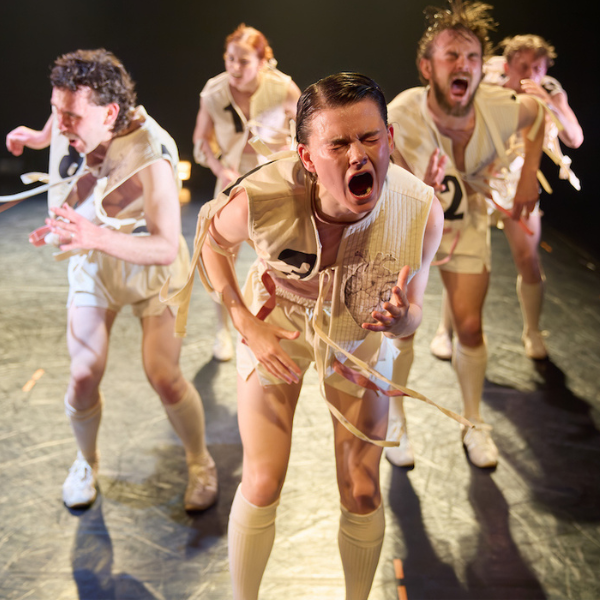
But the issue of whether the audience needs to connect to exactly what a choreographer had in mind was included is complex. Artists often achieve an impact that is not what they consciously intended. The creative process is never precise. The important thing is that something meaningful is put across and Untamed definitely managed that. You feel you want to look away but, simultaneously, you also don’t want to miss a moment, as if you are watching insects at war or bizarre sea creatures hunting. Everything builds towards a climax which is extraordinary in its intensity, making you wonder how long the dancers will be able to sustain what they are doing before they are released by a black out.
You couldn’t say one piece was better than the other. They work together very well in a demonstration of what can be achieved through contemporary dance, a form which is unfortunately a little too niche. An evening of dance is likely to be shorter than watching a full-length play, or even two short plays, but it achieves a similar level of impact, so it’s a pity the audiences are never huge.
An additional issue relating to a choreographer’s intention occurred to me when I looked at the audience at Theatr Clwyd for the show. Those sitting watching, like me, were nearly all middle-aged. It was inevitable that, over and above our emotional response, confronted by the impossibly agile flexibility of the members of the National Dance Company Wales, we would think back to the time when we ourselves could jump for joy, dance all night, run marathons and touch our toes without difficulty.
‘Blue/Glas’ is on tour at venues in England and Wales until the end of November. Get tickets if you can.