

Established in 2016, this year marks the 10th anniversary of Cardiff’s premier international arts festival: Gwyl y Llais. This week-long festival spans storytelling, music and performance with an extra-special focus on voice. We had the pleasure of sitting down with trumpeter Tomos Williams.
Interestingly, each year, the Wales Millennium Centre programmes jazz shows: and this year is no different.
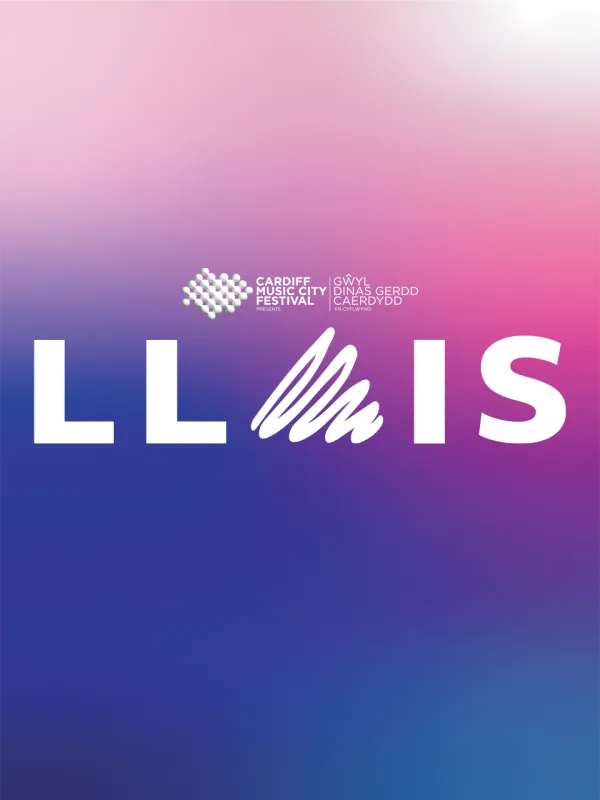
This year, the Cwmwl Tystion collective has been booked to play the Wales Millennium Centre, Cwmwl Tystion is a ground-breaking jazz collective led by Welsh trumpeter Tomos Williams.With three albums created over the past 7 years, Cwmwl Tystion is an imaginative, pioneering and ambitious jazz project. A hallmark of jazz has been its relationship to struggle, identity, and experience: something Tomos has embedded in this work. Cwmwl Tystion has explored the Cardiff 1919 race riots, Aberfan, the Blue Books, Paul Robeson, and other historical significant events spanning Epynt, and Mahmood Mattan.
Each iteration of Cwmwl Tystion explores a theme. The first explored witnesses, and the second explored riots. The last and final iteration of Cwmwl Tystion is on empathy. In a bright cafe in central West Cardiff, trumpeter Tomos explains that he wanted to “go out with a bang”.
Cwmwl Tystion is some of the most exciting jazz to come out of Wales in decades. We had the pleasure of sitting down with Tomos ahead of Cwmwl Tystion’s last gig to ask him more about the project, and the health of Welsh jazz.
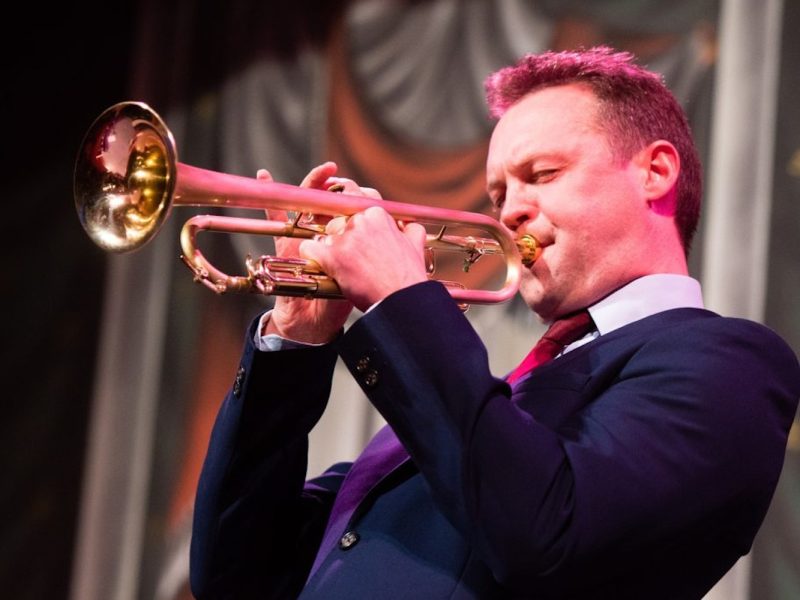
Tomos Willaims
Yasmin: If I recall correctly, the term Cwmwl Tystion is used in a Waldo Williams poem, but originally it’s a Biblical term. What’s the provenance of this terminology and why have you used it for your work?
Tomos: Yeah, so for me that initially came from, Cornel West, the African-American philosopher. I saw a clip of him talking about something and he was talking about a cloud of witnesses. And, yeah, it’s that idea of using the term cloud of witnesses, that idea of bearing witness. That’s one of Cornel’s big things, bearing witness to the African-American experience. It is a biblical phrase, but I also liked how Cornel used it . The use of it from Waldo’s poem. “Pa’ beth yw dyn?” meaning “What is man?” It’s an existential poem,. He deals with what nationalism is in one bit of it, but he also deals in the big issues of humanity, existential questions. He asks’ What is nationalism? To build a house in a cloud of witnesses’ It was mirroring how Cornel used it as a sort of bearing witness to one’s experience. I wanted it to have that kind of dual meaning, in a sense. And I really liked the fact that it was being used by Waldo, because Waldo was a pacifist and a nationalist. And Cornel has been a big influence on me since I was in college, I liked the idea that the phrase Cwmwl Tystion ‘cloud of witnesses’ could be bearing witness to both the African American experience and the Welsh experience. I wanted this to be a project that sort of brought “the Welsh experience” into light.
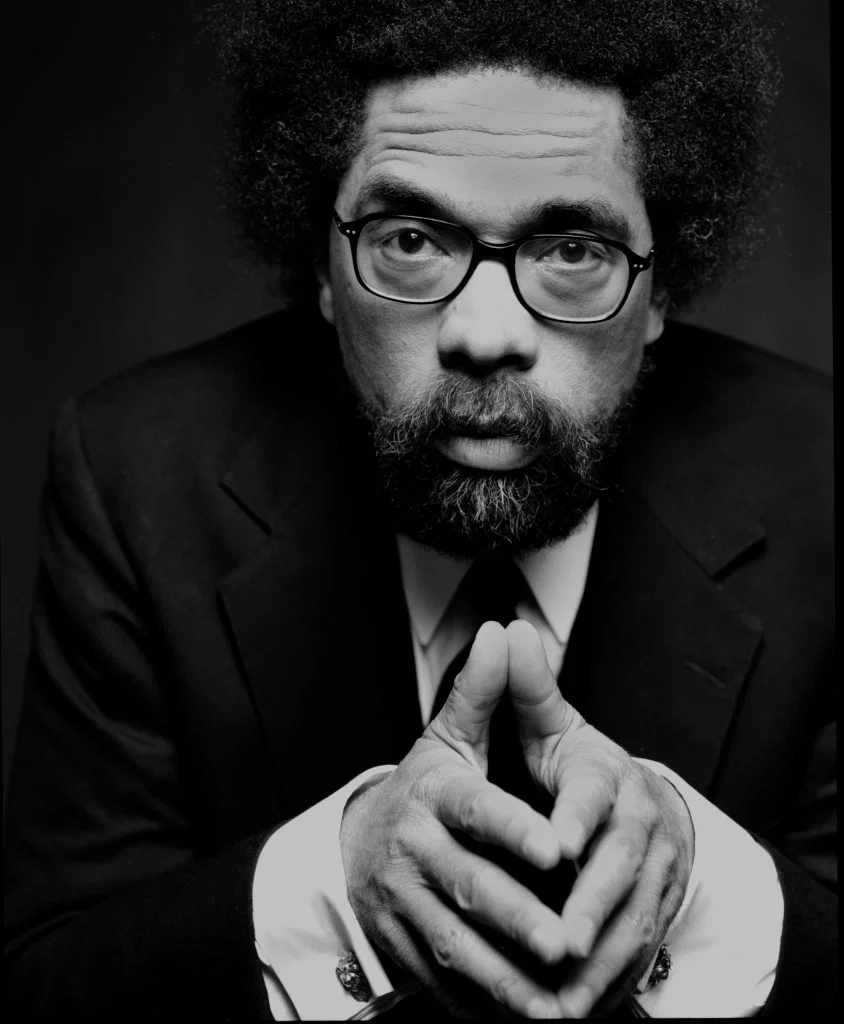
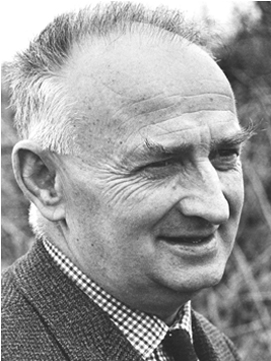
Cornel West and Waldo Williams
I’d also been listening to two amazing projects, one by a trumpeter called Wadada Leo Smith. He has an album called Ten Freedom Summers, which just basically follows the African-American experience from slavery right through to the present day. It’s phenomenal, it’s incredible, it’s massively inspiring. And, you know, it’s like, “Wow, this is what music can do, eh?
And then there’s an artist called Matana Roberts. They play the alto sax, and, they’ve got a series of albums called ‘Coin Coin’ It’s a very personal project, almost a kind of psycho-geography following the path of their ancestors all the way back to the Middle Passage, and then arriving in the US, dealing with trauma, rape, memory.
I mean, it’s incredibly heavy, but it’s an amazing project. And they change the band every album, and I liked that idea. When I started this, it was like, well, I’ll do one project. And after the first one, I then had the idea, hang on, that was good, I could do it again. That’s where Matana Roberts’ influence was in the idea,you could have an overarching project and change the line-up each time. So, that’s more of the musical side, but yeah philosophically, , the idea was, using Cwmwl Tystion as a title because of Waldo’s poem, using that term while referring to nationalism, the existentialism inherent in that poem, and then of Cornel West’s influence, too.
Yasmin: Thank you for explaining this. It’s fascinating to hear more about the project, and its inspiration. Cornel West was a contemporary of Glenn Jordan, whose teacher, St Clair Drake, did his PhD on the topic of Cardiff Bay! Everything always links back to Wales. . If this is the last gig, does this mean that this is the culmination of Cwmwl Tystion?
Tomos: Yeah, yeah, yeah. I’ve decided in my head that it’s going to be a three-volume series. It’s not going to carry on forever. I decided that once I knew that the third one was happening, “I was like, OK, that’ll be the end. Just because it went from being a Welsh-only project to including UK musicians and then the last one was international with Melvin Gibbs and Nguyên Lê : I liked that idea. They’re all different sounding. I think the first one has a bit more strings. (It’s a bit more avant-garde, if you like. The second one is a bit more groovy with Soweto Kinch and Orphy Robinson and the rap. And then the last one is what I call a power trio, which is very heavy guitar, rock-based rather than pure jazz in that sense. I found I’d covered a lot of ground and was like, well, what else am I going to say? So, I felt the trilogy feels good. It will be the end unless we are invited to play somewhere else. So this performance at Llais will be our last one.
Yasmin: What are you working on next then, if this is the end of Cwmwl Tystiom?
Tomos: Well, there are plenty of other projects. I’ve got a band called Burum , It’s our 20-year anniversary next year. I’m putting a tour together of Wales and that’s a Welsh jazz/folk band. We play jazz arrangements of Welsh folk tunes. I’ve also got a new band featutring Edyth Crawford on vocals. Again, we perform jazz arrangements of Welsh folk tunes, but with different players. So, I’ve got Huw Warren on piano, Paula Gardner on bass. They’re kind of my mentors, in a sense, so I’m very excited about this band.
Yasmin: What do you think of what’s going on with Welsh jazz at the moment as a phenomenon? I worry perhaps within Wales we have less jazz than other areas in the UK.
Tomos: It’s certainly pretty hard at the moment . There was the Sandringham Hotel on St Mary’s Street. The Café Jazz used to be there. That was the jazz place when I first came to Cardiff over twenty years ago by now. But that closed just before COVID,I think. The whole thing around live music is in decline , isn’t it? Jazz in particular because it’s a subculture. It’s really hard. But I think Welsh jazz is in a good place because there’s lots of people playing it. There’s just not a lot of places to play it. I and a few other in the Welsh jazz scene have been setting up a new body which is applying now for charitable status called Jazz Explorers Cymru where we aim to promote and increase education of jazz in schools and things. That’s a positive step. We’ll try to make that happen and keep bringing jazz to the people of Wales!
Cwmwl Tystion’s last show is this weekend at Gwyl y Llais at the Wales Millennium Centre. Book your tickets here now.