
 (4 / 5)
Photo credit: Bayreuth Festival
It’s been a whole twelve years since I’ve attended the Bayreuth Festival in Germany. Seen as a pinnacle for opera lovers world-wide, tickets are highly sought after. There are always scandals, I’m thinking back to the head turning Ring Cycle I saw back in 2014 directed by Frank Castorf. This year’s Ring staging saw booing and disapproval due to the use of Artificial Intelligence, though I’ve heard it before and it does not take much to set them off. There are bold stagings and then some! Yet with seats that are notoriously uncomfortable (as Richard Wagner intended) and audiences on the much stricter side, could I make it through the other side?
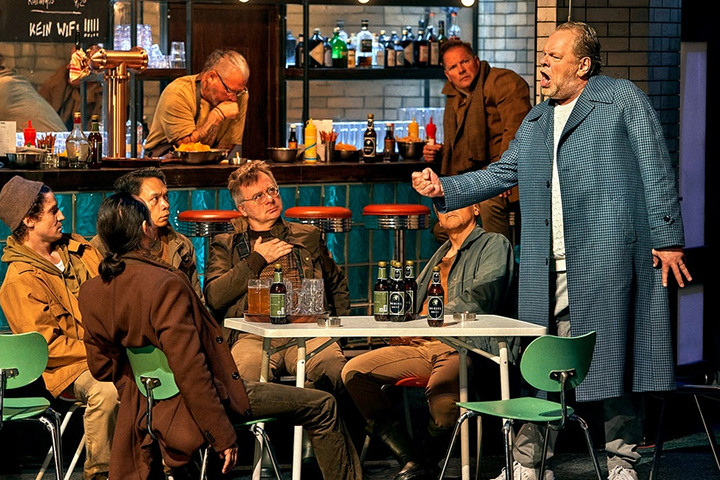
This Flying Dutchman is the second this year for me after the Welsh National Opera fare. Here tackled by Dmitri Tcherniakov, get gaze upon a town of limited al space and constant atmosphere. Sets by also by Tcherniakov would conjure up the model sets to a British viewer Trumpton, moments are highly cinematic a la Ari Aster’s Hereditary. The celebratory scene in the conservatory dining room is vivid, and a snapshot of how this story might have gone down today.
Directors attempt to changes accepts of an opera now. Whilst there are risks here, they work for the most part. The cascading overture features a woman and her child shunned for her fling with a worker, ending with her hanging herself on stage. This was all in the first ten minutes. The ending would drastically tweak things, though it’s clear the curse has been lifted, even with only one half of the tragic duo of Senta and The Dutchman getting a shock death. There isn’t a clear Nordic setting in this outing, some costume choices would evoke the contemporary scene, and the workers don’t appear to have any specific profession.
The singers and musicians are on vividly top form. World class even. Conductor Oksana Lyniv is a rare lady conductor and listening in the pit (which is famously blocked from the audience’s sight) the storm and intrigue, jealousy and redemption all shone through. The chorus are also exceptional, their reputation also unbounded. With the gaggle of sewing women (here they are instead having a singing lesson), male workers with little to do, or the ghostly Dutchman’s crew, they adapt into these roles too easily.
Captain Deland is a near to perfect Mika Kares, a bass-baritone has been excelling with his Hagen at Bayreuth. He can make things softer, the gloss of the voice often rings. Senta is Elisabeth Teige, with parker coat and coloured highlights it’s an extremely stroppy take. Her gutsy aria is earthy; her range is considerable and not without colour. Eric, the eye rolling ex-lover of Senta is Benjamin Bruns. This helden-tendor role is intense for its brevity, the constant bickering with Senta make him very one sided. Bruns takes on the role with a breeze and flow.
Mary the mistress in sewing expertise is given more of a role than just one scene she appears. Nadine Weissmann’s mezzo is friendly, if not always digestible. Her silence in the dinner scene (she is cleverly in a relationship with Deland) speaks volumes and her actions in the finale are what made this new take kin the part quite devastating.
Kieran’s Carrel is the sleepy Steersman who in the opening act loiters around a bar with other “sailors”. Some raising vocals make this small part often cherished. The third act would see Carrel encouraged frippery conga lines (WNO also did similar) and staggered off perhaps to drink some more. Carrel is controlled in the role one that opens the first and third act.
Nicholas Brownlee is The Dutchman. I was unsure at times if he worked int the role. The audience thought so and I came round topped the idea. In stature and expression of voice, he is the man, demanding drama in phrasing and more tender moments for smoother appeal. I was taken with the response tonight; the audience loved it. That’s what I really wanted to hear. Now to Rienzi & Parsifal!
Bayreuth Festival continues till Aug 29, 2026.