
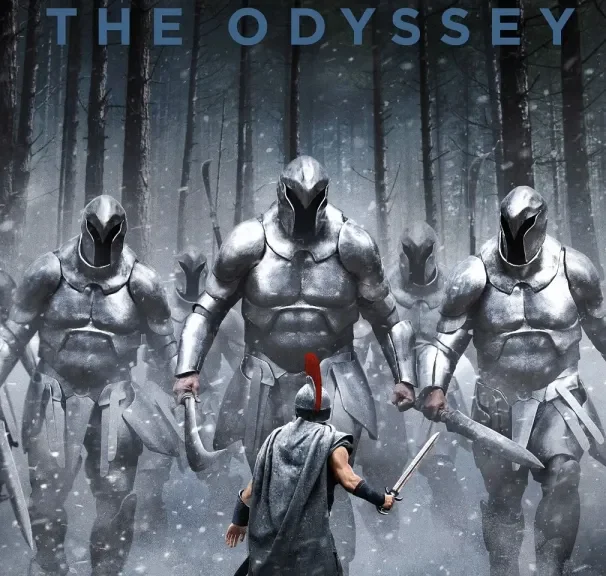
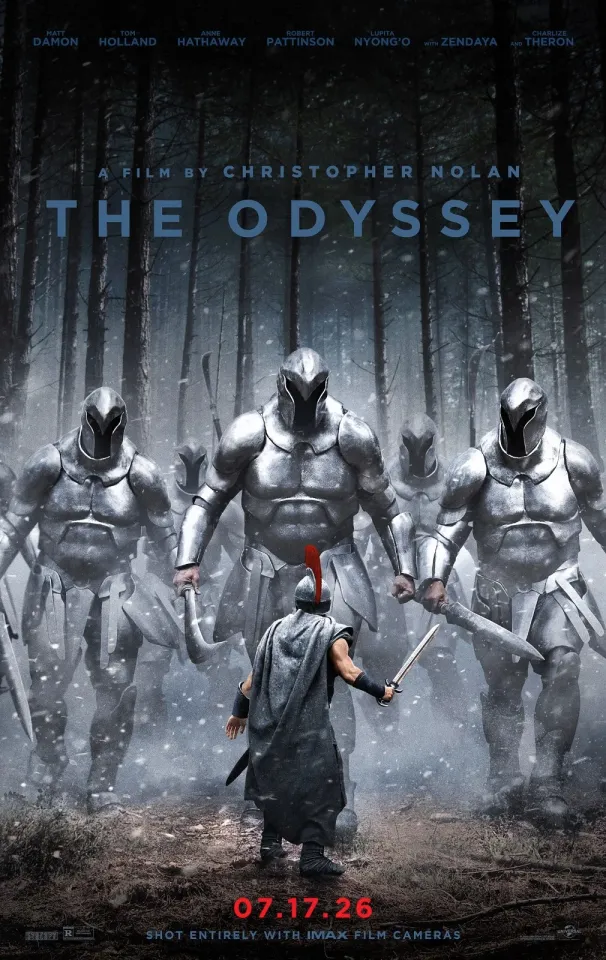
If I’d been stuck on a desert island with only Charlize Theron wearing a designer swimsuit for company for seven years, I’d throw a raft together and push off into the sea, so I understand Odysseus, but does Christopher Nolan?
In Homer’s first epic, The Iliad, men feature as warriors willing to die in the pursuit of glory. If their lives are to be short, they will live on in their reputation for heroism, Achilles being the prime example,
In The Odyssey Homer presented a different type of man – one forced to go to war, but one who wants to survive, who longs to return to his wife, his family and his homeland. In direct contrast to Achilles, Odysseus’ focus on going home once he has done his duty defines him. It carries him through any number of obstacles, disasters and distractions. and means he succeeds, even if it takes him ten long years.
Christopher Nolan’s film version of The Odyssey suggests he has confused the epics. Because it allows him to make an action movie, he stresses Odysseus’ capacity as a warrior chieftain rather than his capacity as a lover, husband and father. His Odysseus (played by Matt Damon) is obsessed with Troy rather than Ithaca
Nonetheless, from one angle, Nolan’s treatment is a success. Wikipedia provides the details.
In the first month after the film’s release, it may have grossed as much as $1 billion worldwide, a good return on a production budget of $250 million. In France, it was put on in 730 cinemas and attracted an audience of nearly a quarter of a million on its opening day. The income will drop off in the months to come but that hardly matters. Nolan had a good day at the office.
The secret behind this financial success is not hard to find. Of his $250 million production budget, Nolan may have spent half on marketing. This reminds us how modern culture is driven by economics, not by a need for glory or love. The basis of creative activity is now the bottom line, not the aesthetics. The consequence is today’s cultural products are disposable. Nolan’s work will soon be forgotten, drowned under the constant mass production of other films and the tsunamis of other visual media. This won’t concern Nolan himself because he has achieved his fifteen minutes of fame and the fortune he has amassed in the process will do very nicely, thank you.
In terms of absolute success, it is worth remembering though the source material his film muddles through was composed approximately 2,700 years ago and is still very much in circulation. Indeed, Nolan’s film has driven up its sales in bookshops and online. So there’s a contrast. Getting on for three millennia ago, one man (probably) using the most basic of tools – pen and paper – organised a set of myths and legends to construct something meaningful and way beyond the likes of Nolan. The delivery of Homer’s epics only required a lyre and a good singing voice, not a multi-million-dollar technological studio system or an IMAX cinema.
Beyond the momentary hullaballoo of financial returns and audience numbers, there is not a lot to be said for Nolan’s film.
Given the scale of The Odyssey’s marketing budget, criticism is redundant. What is said about it will not influence the numbers of people seeing it. But the comments that have been made show where we are with contemporary critical appreciation. Broadly speaking, those who like escapist family entertainment suitable for twelve-year-olds are in favour and those who like reading and thinking are against. Thus, Peter Bradshaw of The Guardian gave The Odyssey five out of five stars, calling it “a film with thrilling ambition, boldness, seriousness, generosity and flair”. (Seriousness, really?) Mary Beard, on the other hand, described it as “an Odyssey without the sex”, lacking the “elusive… humour” of the original. (Again, Wikipedia + AI.)
Gushing in The New York Times, Manohla Dargis described the film as “an anomalous big-studio entertainment that Nolan has filled with stars and polished to a high gleam, turning a 3,000-year-old poem into a smart, thoughtful film with Old Hollywood allure.” (Thoughtful?) But Emily Wilson, whose 2017 translation may have been a resource for the film, decried the film in the London Review of Books for lacking “psychological, emotional, political and ethical depth”, labelling the writing “abysmal”, and arguing that it had “nothing convincing to say” about the Odyssey’s major themes.
Wilson was certainly right about the writing of the dialogue. I went along with the not-too-gruesome action scenes, and I even appreciated some of the IMAX boosted special effects. Polyphemus the Cyclops was scary (until he shrank to a third of his size when he lay down to sleep). The giants were impressive killing machines, even if they looked like refugees from Star Wars. The wooden horse was memorable too, even if it fell over because its wheels had come off. I felt as if I was on a boat during the voyages. The ancient world costumes were good – they had probably come out of studio storage warehouses.
But where it all fell apart – absolutely – was the dialogue. I winced every time there was a conversation. What got said ejected me out of the escapist historic situation and brought me crashing back to twenty first century reality with a jolt. Odysseus talked to Calypso (Charlize Theron) as if she was his therapist, not his mistress. Telemachus talked like a frat boy, looking forward to seeing his ‘mom’ and ‘dad’ reunited. When his dad did eventually turn up, he was as pleased as any dad might be on graduation day. Nolan simply couldn’t handle the tension of the ultimate family reunion.
The conversational disasters were not the result of the use of American accents. They were simply the product of Nolan’s fashionable reliance on action to move the story on and to impress his target audience. He wasn’t interested in using dialogue to reveal individual psychology or explore complex dramatic situations. He wasn’t going to waste time on intimacy or sexual activity. Odysseus and Calypso wander along the beach not even holding hands. There is no chance of Odysseus having a fling with Circe, either, although he is said to have fathered at least one child with her. And no sooner is he reunited with Penelope (after an absence of twenty years) than the two of them are getting on to a boat to sail off and pay their respects to the dead. The huge and completely unrealistic fight with the suitors is no substitute for the meeting of a husband and wife after twenty years (a lifetime in the ancient world).
Despite what Manohla Dargis claims, you don’t think about a man’s singular need for his family and his home as you emerge from the IMAX with your ears ringing. You don’t wonder if the arguments and ideas of the ancient story are still valid. And despite Peter Bradshaw’s review, the only serious thing about this Odyssey is the profit Nolan has made.
Instead, what goes through your mind is how you can make unconscionable amounts of money by resorting to a lavish collage of Hollywood clichés and peopling it with a cast of celebrities. You can update Ursula Andress’ bikini scene, using Charlize Theron as Calypso; you can squeeze in pop star Zendaya as Athena (even if you can’t think of anything for her to actually do); you can have the rapper Travis Scott (without his signature Nikes) as a bard; you can even revisit Batman with your Agammemnon. You can invoke the ‘Old Hollywood’ ghosts of Charlton Heston and Richard Burton and Elizabeth Taylor. You can even reference Bruce Lee and all those endless kung-fu show-downs where the hero dispatches a minimum of thirty adversaries.
The one thing you can’t do with all the resources at your disposal is create a work of art.