
An arts centre I used to work with would hire out its venue to a successful amateur company every year. They would fill its seats for three nights. This provided valuable income, as the centre struggled to attract audiences to professional touring work, even when this was of high quality. One type of event required subsidy; the other was self-funding. Interestingly, the audience who turned out regularly for the amateur company, who might have seemed to be theatre enthusiasts, did not attend other types of performance.
UK society is compartmentalised, often as a result of economics, with people falling into particular camps – those who follow jazz but not folk music; those who read novels but not poetry; those who enjoy photography but not modern art. People are often sure they know what they like and are unwilling to risk a night or day out, with its attendant costs, if there is a risk of not enjoying what is on offer.
It’s not a question of skill levels. Professional productions in whatever genre are likely to be technically superior and professional performers and artists are likely to be better trained and more experienced than amateurs, but their work may not be accessible. Both the work and its interpreters, because they are famous and established, and the places where it is to be seen may be considered ‘not for the likes of us’. Alternative offerings, like amateur productions, seem less pretentious.
Then there is the obvious but very significant point that the arts economy cannot support more than a fraction of those with talent and a passion for what they do. Fringe cultural activity is sometimes excellent. Many amateurs might have been professionals.
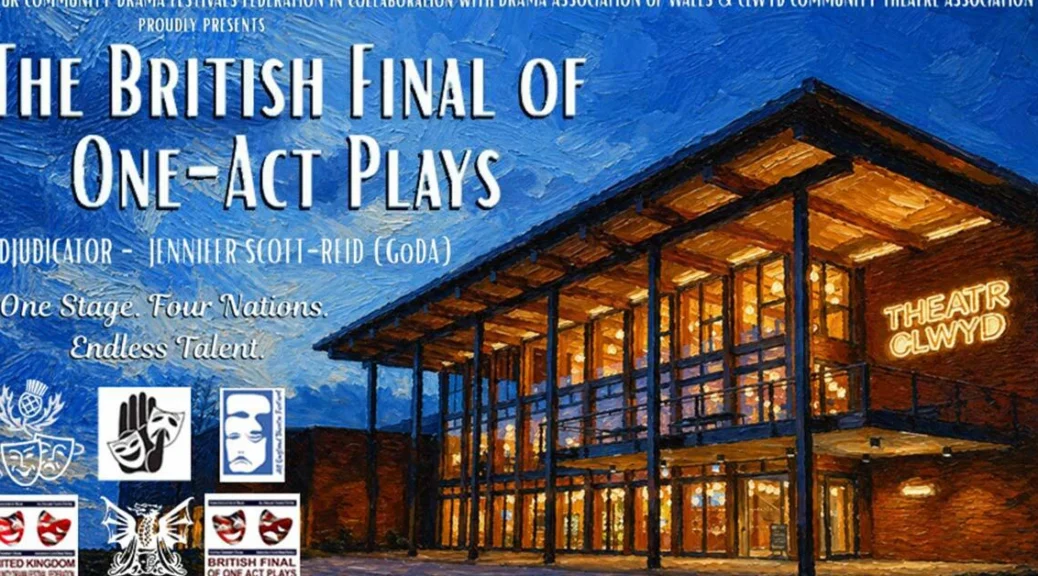
Which is a roundabout introduction to the British Final of One Act Plays, the culmination of a festival now 99 years old but one that goes under the radar. The event is run by the United Kingdom Community Drama Festivals Federation, a partnership of organisations in England, Scotland, Wales and Northern Ireland. Every year, after a series of eliminating rounds, the best one act play to be performed by an amateur company – or community group as they prefer to be known – from each country, is entered into an adjudicated final. Detailed feedback is given and the winners take home the Howard de Walden Trophy (donated by Thomas Evelyn Scott-Ellis, 8th Baron Howard de Walden—apparently a prominent British peer and a ‘patron of the arts’.) The annual event is thus large-scale. This year its final was held at Theatr Clwyd, as part of the celebrations for the 50th anniversary of the opening of Theatr Clwyd itself.
Not grasping how the event is organised (read the publicity…) I only attended on one night, the Saturday, seeing the Scottish and Welsh entries but not the Northern Irish and English ones. This was a pity as the English entry, ‘The Weight of Small Things’ by Tilly Lane, performed by TACT – Total Arts Community Theatre – was judged the best of the four. TACT, based in Tamworth have no permanent theatre base but this doesn’t seem to hold them back as they have won the competition more than once.
Despite missing out on TACT, it was worth going to see Aberdeen-based Bon Accord Players’ take on Metamorphoses, an adaptation of several of Ovid’s stories, and Penarth Operatic & Dramatic Society’s All By Myself by Robert Scott. (The event provides a platform for original writing as well as versions of the classics. Works by Chekov, Jim Cartwright, Pinter, John Godber, Arthur Miller and Alan Bennet have won in the past.)
I might not have been so generous in my feedback as this year’s adjudicator, Jennifer Scott-Reid, but she had a difficult task, being required to chose quickly between what were quite different shows. However, she was thorough and detailed in her comments and hearing them added to the general interest of the occasion.
I agreed that the adaptation of Metamorphoses by the American playwright and director Mary Zimmerman, then reworked by Sami Ibrahim, Laura Lomas and Sabrina Mahfouz, was original and ambitious. It gave considerable scope to four energetic and ingenious performers who had to interpret a range of characters on a minimal set. It was good to be reconnected with these once-famous stories, the only drawback being they are complete mini-narratives in themselves and collectively do not constitute a dramatic process.
Also, while I followed the stories of Arachne and Orpheus with interest, I think the performance missed emphasising the meanings behind these myths. The first illustrates the danger of thinking you are The Greatest (Weaver) Of All Time; the second reminds us even True Love cannot conquer death. To make their show truly relevant, Bon Accord might, too, have linked the story of Baucis and Philemon to current attitudes towards foreigners and immigration. In Ovid’s telling of the tale, an elderly couple are rewarded for their spontaneous generosity towards two destitute strangers by being allowed to die at the same time. They then live on as intertwined trees, in a poetic image that today has considerable political resonance.
All By Myself could not have been more different. It’s a quick-fire farce based on a simple situation – that of being cast away on a desert island – and a lot of fun is had playing with the idea of what happens when one Crusoe finds out he is not alone. I thought the Penarth cast were confident and committed. Their comic timing was spot-on. Considerable attention had been paid to their costume and appearance and to the set. Anyone who appreciates live theatre would have enjoyed this little show which made the audience on the night laugh out loud repeatedly. My only cavil is that, of course, it remains a farce, a built-up sketch in which a straight man is confronted by a team of clowns. It does not pretend to be anything other than light entertainment and it does rework a number of ideas (and jokes) that have been tackled before. It might have benefited from a silly song or two and it could even have included some slapstick.
It’s important to mention that there were no wooden performances or any corpsing. There was no need for prompting and none of the scenery looked as if it would collapse. In short, there were none of the common and embarrassing weaknesses of amateur (or community) work which we have learned to expect and which we have to forgive. I saw two pieces of strong ensemble work in which lines were delivered clearly by performers moving naturally and even gracefully around the stage. The acting throughout was as good as anything you’d see on TV. The pieces performed suited the talents and aspiration of the companies, something that cannot always be said of professional shows.
Might the National Theatre might consider hosting this event in the future? As it is well attended, there would be no loss of revenue. The National could confer some prestige on work that is popular. Hosting the final on the South Bank would recognise a sector of the UK theatre community which, at its best, is worth celebrating.
Simon Kensdale
I’m curious whether the National Theatre would actually consider hosting the British Final of One‑Act Plays, given its strong community appeal and potential to draw new audiences?