 (5 / 5)
Please note there may be a slight spoiler in this review.
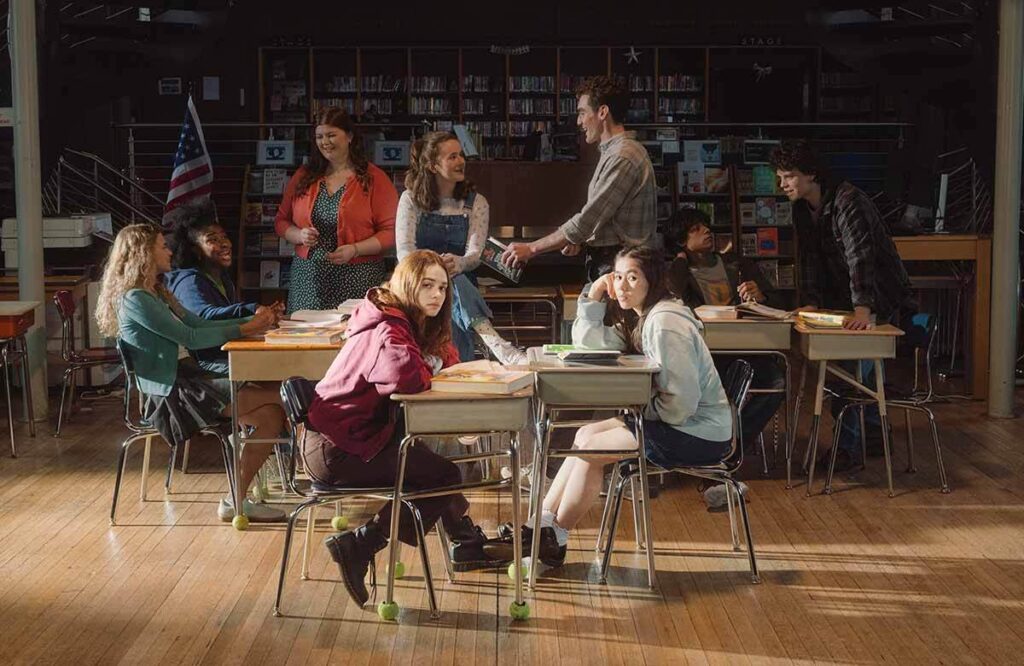
Harking back to many a youth, we are catapulted into an American school room to be amongst the teens, as they start to face questions around love, sex, misogyny and pop stars. They also have to face school, with all its complexities and a latest assignment, based on The Crucible.
John Proctor is the Villain is a story about a group of young, high school girls, around the time of the Me Too movement, with its impact on them, the local community as well as the trials of growing up, boys, pop culture, feminism, growing bodies and minds and confusing feelings. We see it from their conversations in their literature class with their young male teacher, their after-school feminist club and the moments in between, before and after school where an empty classroom is meant to be a place of sanctuary but doesn’t hold itself as that safe space. As they delve into sex education and The Crucible, their lives unravel, almost mirroring the story-line of the play with woman being the blame, men supported for wrongdoings and gossip running riot, resulting in them really reaching their feminist height, pulling the boys along with them and fighting back.
Remembering my own days of reading and performing The Crucible at school, this already evoked memories of discussing the play and its impression upon me as a young wannabe-actor. However, even these nearly 20 years later, I found myself newly informed and immersed in the discussions, factoring that John Proctor was pictured a hero and the women still as the villains. A story about the dangerous spread of gossip and rumour, we still side with his stoicism and rarely comment on the play being written by a male and the male view on the female characters. I found myself already with a renewed outlook, feeling like I was one of the girls discussing this and all the interpretations. Oh my horror when I remember how I was cast as Proctor way back when…
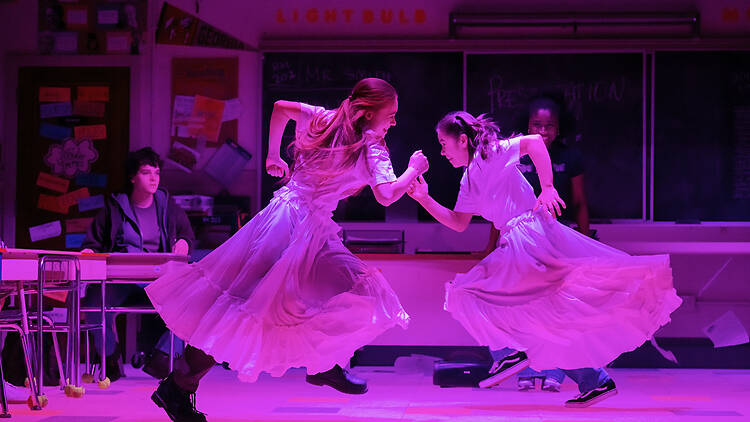
There’s a real sense of relatability as a female – while set in America, teenage girls are teenage girls, and all the performers (Lauren Ajufo, Holly Howden Gilchrist, Clare Hughes, Miya James and Sadie Soverall) evoke that youthful-ness, excited-ness and awkwardness that we all felt at that age. In a specific time where our minds and bodies are growing, our brains being somewhat working towards adulthood but still children, they brought this to life without it feeling satirical or unnatural. Each with their own personalities, there was no stereotyping here but something still very relatable. The excitement over a boy liking you, the girlish crush on your young teacher, the blow ups of friendships and family… all so normal yet still so dramatic. We want to be part of them, and we gasp and laugh as they do. We want to dance when they dance and we cheer them on when they fight back. Their relationships are so easy and natural and funny – so teenage and so girl-like. I can remember those moments with my own friends back at school.
When things get hard, we feel it. And we remember it from our own time. While the shocking turn of events may not have happened to us in our lives, we maybe heard stories of it in other places with other people, and went through our own serious moments while trying to grow up and be children at the same time. It’s still shocking and the theatrical techniques used to drop these bombshells is impactful. It only heightens the great acting on stage. The lighting, scene changes, spotlights highlighting character’s feelings at the time, all add to enhance this production from the script to the stage.
One can’t go without a mention of Dónal Finn. Like many, I am on the Finn train after his recent appearances in The Other Bennet Sister and Young Sherlock. Already two very different characters in themselves, Finn throws in yet another drastic change of character as Mr Smith. A likeable, excitable character, we can’t help but have a girlish crush ourselves and lean to liking him. So when things are turned upside down, the change from our impression of him is still as shocking. His character doesn’t change necessarily but it is felt under the surface; something running as a current. And his uncomfortable-ness at the crescendo is plastered naturally across his face and enveloped in his tense body language, ready to burst. If you happen to see all 3 of these credits in quick succession, you will see what a real upcoming talented star this man is becoming. One to look out for.
John Proctor is the Villain is a triumph of a production, relatable yet sufficiently dramatic. It questions everything we were ever taught about a fantastic play and forces us to continue to question feminism and the long way we still have to go.