
Verve is the international touring dance company from Northern Contemporary Dance school – a school responsible for producing some of the most talented new dancers working in contemporary dance today. In Verve students work towards an MA in contemporary dance performance whilst training, making and touring work – giving them professional touring experience.
Verve has a reputation for bold, creative programmes that flex the students’ skills and offer opportunities to work with some of the most exciting choreographers from across the UK and Europe. The Verve 2026 tour was proof of that ethos, featuring three different works by choreographers with a reputation for being cool.
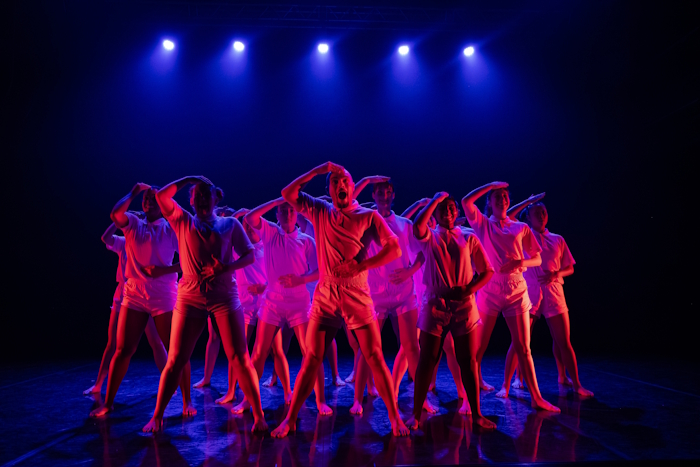
B O D Y B E by Andrea Costanzo Martini photo by Elywel Photography
The evening opened with B O D Y B E by Andrea Costanzo Martini – an Italian choreographer with a hefty online presence. Martini is fascinated with the simple beauty of bodies and with the act of making and watching dance. His style is light, theatrical and almost wacky but woven with lingering moments of beautiful choreography which is always a joy to watch.
The show opens with a cluster of dancers dressed in simple white t-shirt and shorts in the centre of the stage. Together, they turn and notice the audience, gasping, their faces contort in cartoonish fear before they turn away and utter a drawn out ‘F-word’. With this the tone is set for the work – a playful commentary on watching and making dance that brings the audience with it.
Everything about this work varies between humorous and beautiful, stark and soft – the lighting, the music, choreography and the dancers’ expressions all do so seamlessly. There aren’t many choreographers who like to use facial expressions and these young dancers have obviously worked hard on character, clowning and vocal work alongside their dance training.
The dancers speak often, telling us about the amazing things bodies can do, telling us what watching dance can be like and how incredible it is to have a body.
At one startling moment they point directly at the audience and ask how we feel about our own bodies – I’m sure I wasn’t the only one that thought in the negative – but the team continue, listing all the little things that we are that make us amazing. Hair, freckles, two arms, two legs. A body. It’s hard to argue with that.
After the stark white costume, lights and commentary of the first section the lights dim. We’ve heard about how to consume dance, now we get to watch it. A vibrant red strobe, pulsing, driving dance and some incredibly complex sequences create an impressive spectacle. You can tell the dancers of Verve enjoy this work, and the audience loved it too, laughing freely throughout and ending with rapturous applause. Human, honest and tongue in cheek this is as enjoyable to dance aficionados as new-comers.
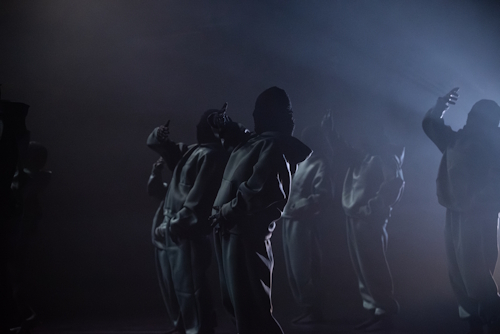
We Question. We Try by Alethia Antonia photo Elywel Photography
After a short pause the second work of the evening began. We Question. We Try is a shorter work by West Yorkshire based choreographer Alethia Antonia. From my reading this work focussed on isolation of growing up in a digital world – of the importance of community.
At the start of the work the dancers are dressed in oversized grey tracksuits that change colour with the strong lighting pleasingly. The dancers’ hands and faces are covered in black gloves and hoods creating anonymous faces and bodies that move together to a deeply cool soundtrack rife with digital glitches. This choreography is fast and complex interspersed with smooth and athletic solos. The opening section gave me the impression of nameless, faceless online trolls – perhaps prompted by the digital moments in the music.
As the piece continued the dancers begin to remove their tracksuits and put on their own individual clothes. I wonder if dancers chose their own outfit for this moment as it felt incredibly authentic. As they undress, they stuff their tracksuits in a backpack, seeming to shove down the emotion and anger of the previous section, now standing confidently. Rising tall, working together, encouraging others to do the same.
This work moved from inhuman to human with ease, and though it could feel a little tropey it also feels important to the young people dancing it. They grew up in a world where finding oneself and feeling confident alongside the pressures of social media is a difficult thing to do – and there was a real authenticity to this, and some complex choreography that fitted solidly between two more theatrical works.
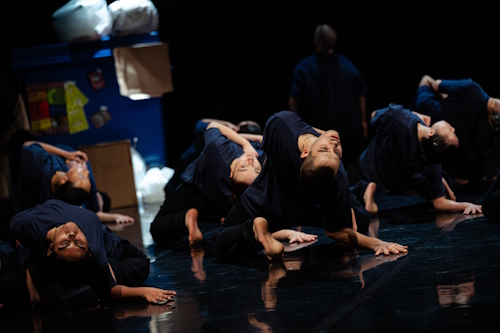
Hope Hunt by Oona Doherty photo by Elywel Photography
After an interval the evening finished with Hope Hunt – a restaging of Oona Doherty’s 10 years since it was created. Oona is known for distinctive, theatrical and physical dance shaped by the landscape and tensions of working class communities of Northern Ireland.
Once again this performance asked the Verve performers to draw on their vocal skills but where B O D Y B E was tongue in cheek – Hope Hunt is raw, confrontational and visceral.
As we entered the auditorium after the interval the music was blaring as if entering a club and the audience bopped and nodded along the isles to their seats. Throughout the piece sound was used to build the landscape of the work. Music, documentary clips and the dancers’ voices, breath and bodies layered together to create a complex sound-story.
As the work began the house lights stayed up but slowly, seamlessly they faded out and with it, the soundtrack switched speakers – playing only from those facing the stage – creating a bubble for the performers where the audience were sat outside and looking in – as if walking past a club at night. Here we begin to understand the context of this work.
The freesheet noted this piece aims to “create kinetic empathy for the lads, smicks, hoods, nerds, chavs and roadmen” that everyone deserves the chance to be heard and understood.
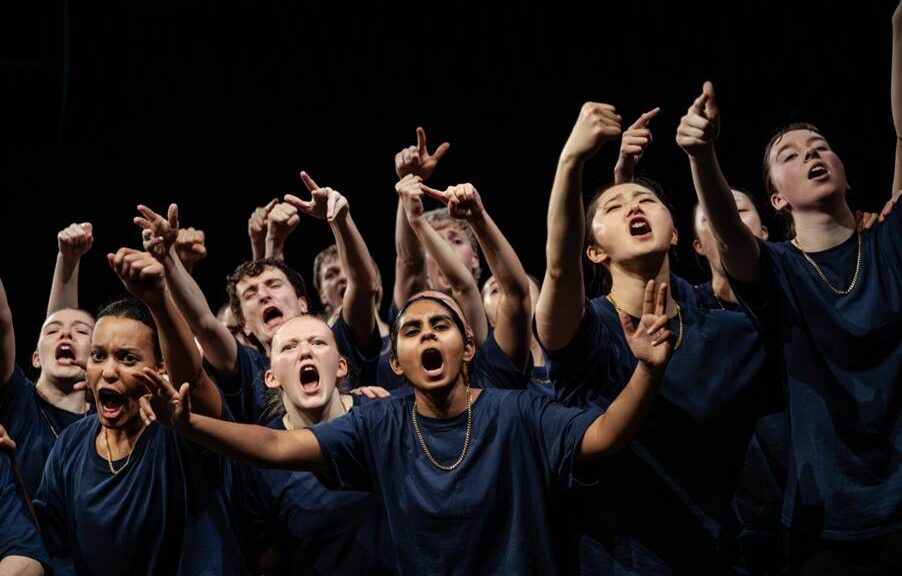
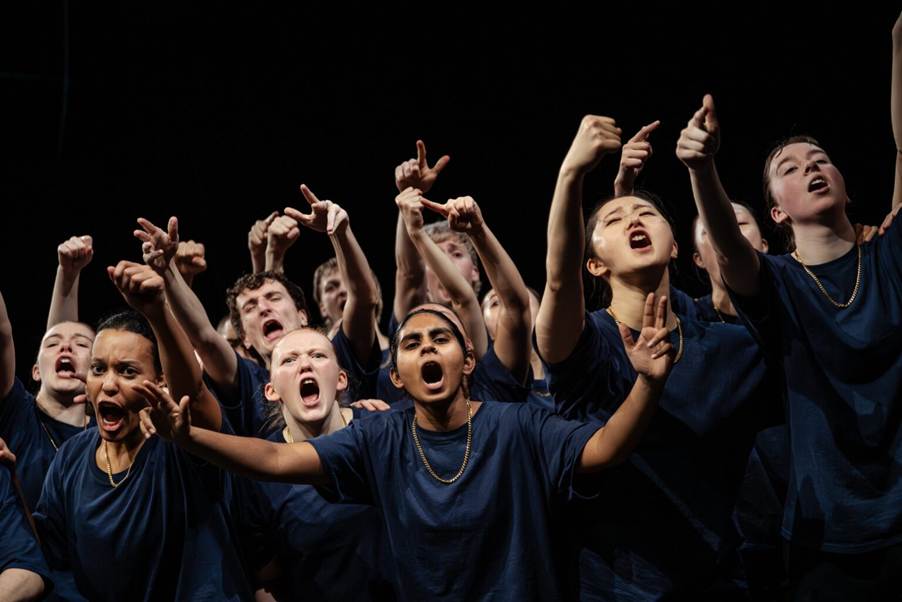
The dancers are dressed in dark blue t-shirts and trousers and gold chains. Their general body language is one we all recognise – bravado, feigned confidence, laddishness, vulnerability. On stage a blue skip is illuminated, and the lads begin to jostle, fight, dance – movements switching from solos, duets and and in-sync work together seamlessly, sometimes dance, sometimes physical theatre, always impactful.
The physicality of this piece is accompanied by full bodied vocalisations. Sounds and words are shouted, whispered, barked and repeated often turning from one thing into another. This is a work where the 17 strong cast comes alive, the sheer number of them makes the ‘lads’ feel all the more intimidating – yet as the work progresses you can see their sense of community, their sheer sense of need to connect, to feel connected.
In the closing phrase the dancers huddle together shouting a punched out ‘h’ sound together, violent and visceral. As they continue it turns desperate, a word emerges. ‘Hope’ – together the lads shout and beg for ‘hope’. Slowly the dancers drop off one by one, the spotlight on them an ever-reducing circle of isolation until just one screams ‘hope’ into the dark.
Oona’s work isn’t passive, it’s an experience, aiming to encompass the audience, to drag them along, to invite them to think – and you could feel this one with your whole chest.
Verve’s 2026 programme is a big win for Artistic Director Matteo Marfoglia – the three works showing the strength of the dancers physicality, their acting, vocal work and versatility. For an audience the experience feels enjoyable, dynamic and thought-provoking, and above all cool.
Photos Elywel Photography