

Category Archives: Uncategorized

Review, The Nature of Forgetting, Theatre Re, Ed Fringe, By Hannah Goslin

 out of 5 stars (4 / 5)

In collaboration with the Alzheimer’s Society and Neuroscience Professor Kate Jeffery, Theatre Re bring a heart warming and breaking tale of dementia in physical theatre form.

Based in one of the Pleasance Courtyard’s biggest spaces, the stage is taken up by a skeleton stage, with all the props, costumes, staging for ever changing scenes on bare display. Throughout the production, changes in costume and set happen in front of our eyes, bringing a no-secrets and vulnerable view to the production, perfect for such a touching and vulnerable tale.

The Nature of Forgetting is the story of Tom, 55 years old, living with dementia. As his birthday approaches, he is soon triggered into viewing past memories and reliving his former years. This includes childhood all the way to the present, with relationships with his mother, his budding romance with his school sweetheart and the birth of their daughter and his best friend throughout all this time.

On a square piece of platform is where the majority of the action takes place. Supported by a live band at the back, little speech is heard but perhaps the occasional name or murmur of interaction. This is mostly physical theatre and dance and is very high energy. It is beautiful and fluid and happens so effortlessly. It is playful and highly interactive between the performers. It clearly and artfully tells Tom’s tale, with plenty of room for simple interpretation. As any physical theatre or dance requires, there are feats and movements that are only possible through brilliant skill but somehow are made to look completely easy. They do this and successfully evoke the roller coaster of emotion we feel through the highs and lows of Tom’s life.

While the performance needed a big-ish stage and was highly popular, therefore needing plenty of seating, it felt a little lost in this space. No matter how big the performers movements, it felt a little diminished in such a large space. The beginning began with Tom and his daughter, not mic’ed up (and usually I am actually against mics anyway) but their vocal interaction, no matter how brief, got lost in the vastness.

The Nature of Forgetting is a touching and heart breaking tale of dementia, the ease of confusion and how it can propel one into the past, all elements that people with dementia likely experience. It takes us through the love and loss through a normal life and one affected by dementia and is energetically and effortlessly performed, resulting in a beautiful piece of work.

Review, Dear Annie, I Hate You, Wild Geese Productions in association with HFH Productions, Ed Fringe, By Hannah Goslin

 out of 5 stars (3 / 5)

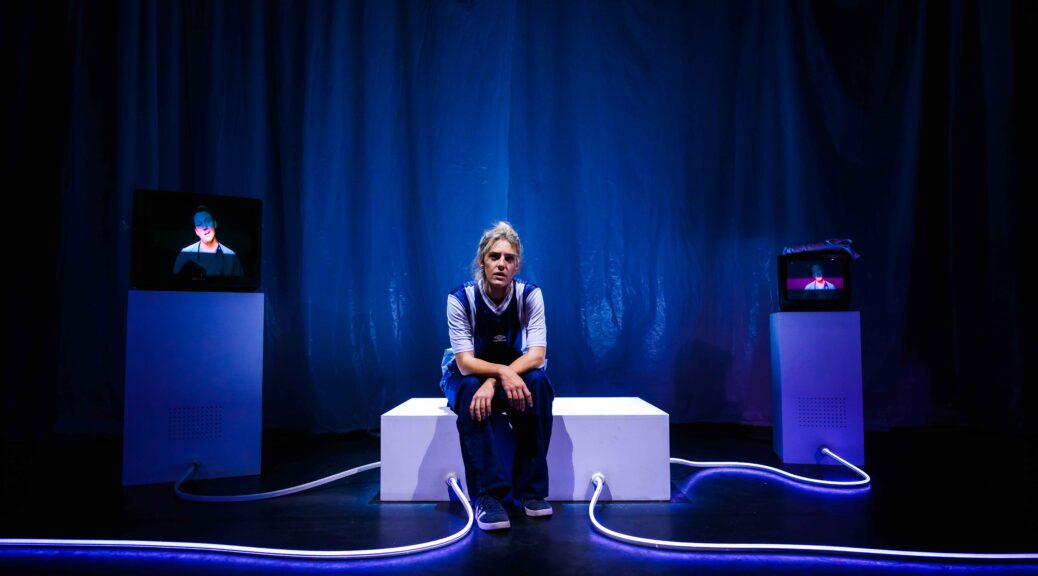
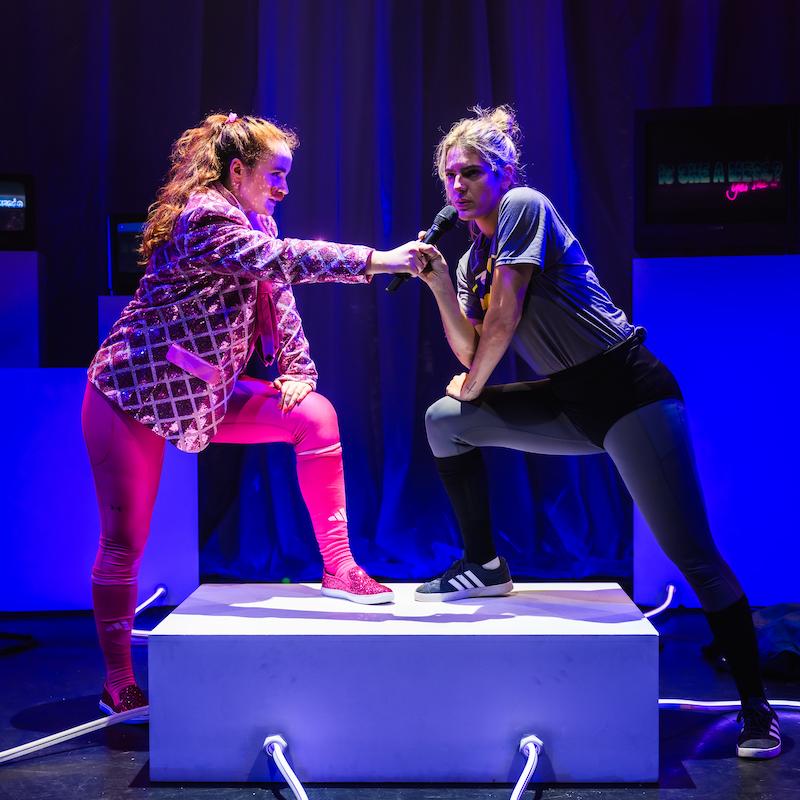
Confronted with different staging, a Dexter-style plastic back drop, old chunky TVs and lots of wires, we have entered Dear Annie, I Hate You – NOT a play about a severe dislike of Annie the musical, but about something much deeper.

Based on Sam Ipema’s true life, Dear Annie […] is the story of Ipema’s diagnosis of a brain aneurysm at 20. We live through her short life up to that moment, her family relationships and then post diagnosis and how she copes with this change. With the high potential of life and personality changing consequences should she have surgery, she begins to question what is more important, life or death, in many different guises.

The production does well to squeeze so much content into such a short space of time. We quickly and easily get a sense of Ipema, her life and her family, with interjections on the TV from her family to make it rounded. These screens are connected to tubes that light up and escape their connection, depending on the points being explored at the time. However, a lot of the narrative accompanying this becomes technical and scientific and, while very interesting and important to explaining her brain and how the impact of the aneurysm, sometimes it just lost me and I felt a little out of the loop of truly understanding.

Ipema is high energy, utilising the space and hopping from podium to podium and up the stairs, banishing the idea of any impediment the aneurysm should have. Unfortunately, sometimes her run up the stairs felt out of place and unnecessary, not really adding much to the story. The energy level continues high when Annie comes in; the physical embodiment of the aneurysm. It is said a lot that some like to put a name or visualise what they are coping with as a person or thing, and this is clearly how Ipema coped with this. Unfortunately, Annie is often the voice of reason, urging for truth, and through her high octane presence in the space being purposefully annoying, she often takes a higher road to Ipema, blurring the lines of good and bad.

The play ends up with Ipema thanking Annie and this feels a little confusing and misplaced. It doesn’t feel like there is a revelation that is needed, with a simply fine life pre-Annie, and it feels as if there was a need for an ending and a story moral that couldn’t quite be found. But, we are dealing with a true story and one critic shouldn’t be the judge of how one copes with something like this and what brings comfort.

Dear Annie, I Hate You is well executed in its production values and an enjoyable retelling of a true experience. However, the narrative and dramatic licences taken felt slightly out of place and unfulfilled.

Review, Dru Cripps: Juicy Bits, Ed Fringe, By Hannah Goslin

 out of 5 stars (3 / 5)

In a bright yellow container, we are encompassed by the comedy stylings of Dru Cripps. Suggested to me by another fellow comedic clown, I await to embark upon an hour of improvisation.

Beginning with a mime act, engaging with the audience and immediately getting us to create sounds with his prompt through mime, the room soon descends into chaos with a few more rambunctious amongst us providing more of the content for Dru to pull upon. With his smiling face, he takes this in his stride and uses it fully to his advantage; it does almost feel as if it was scripted and planned.

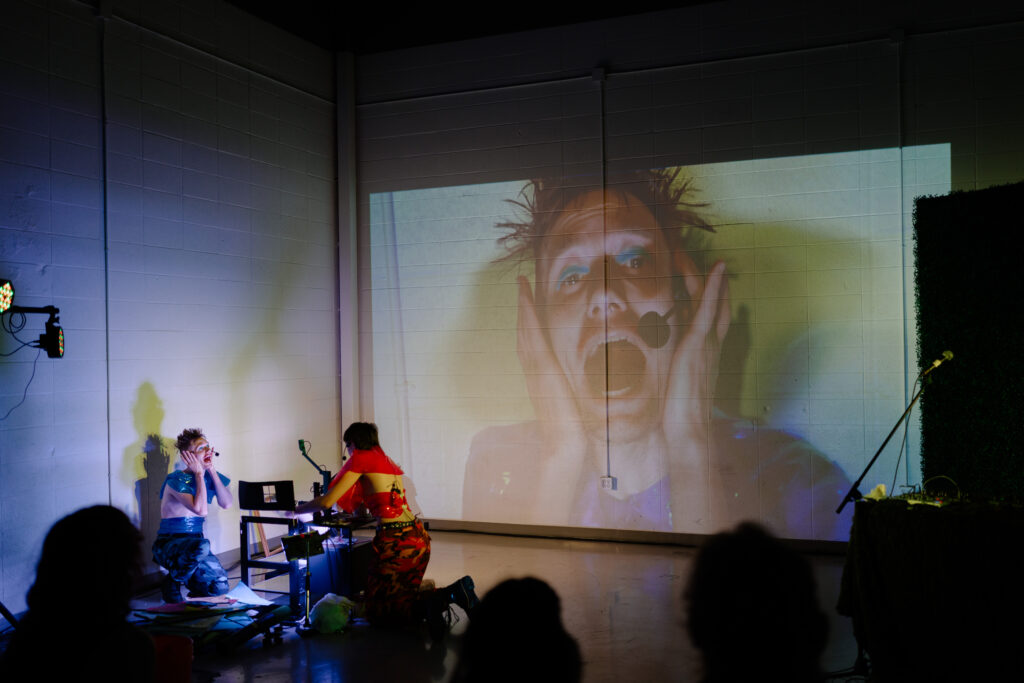
The wool is pulled back from our eyes as Dru reveals he indeed can talk and we start a different part to the show using his loop machine to create music, prompted by selected audience members on jobs, interests and music tastes. His quick uptake and ability to create a song is really clever and skilful but there is still a slight essence of unsurety and nervousness in his engagement, understandable for such a big festival.

Dru doesn’t let anything stop him – when the unplanned power goes out and descends us into darkness, it takes a moment for Dru to pause in the hopes that this comes back quickly. When it doesn’t, he improvises a funny but slightly scary moment in the dark, using a torch and the length of the container, and this adds to our giggles.

Dru Cripps: Juicy Bits is a fun performance to be surprised by and ideally what Fringe is about; something unusual and unexpected, in amongst the big flashing lights. He has a great career ahead of him with a little bit of confidence in his abilities.

Review, Knight, Knight, Madeleine Rowe, Ed Fringe, By Hannah Goslin

 out of 5 stars (4 / 5)

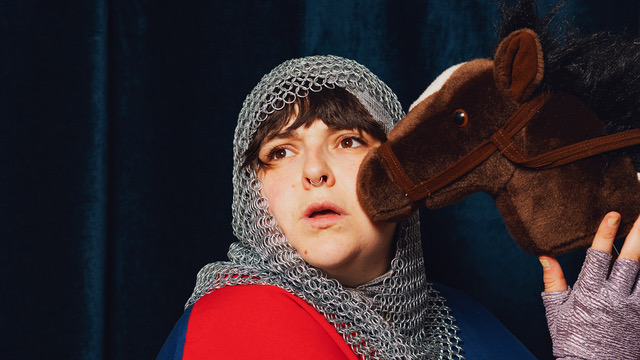
We’re all familiar with tales of Knights, pulling swords from stones, their round tables, lots of chainmail. But have you heard about the one with the horse?

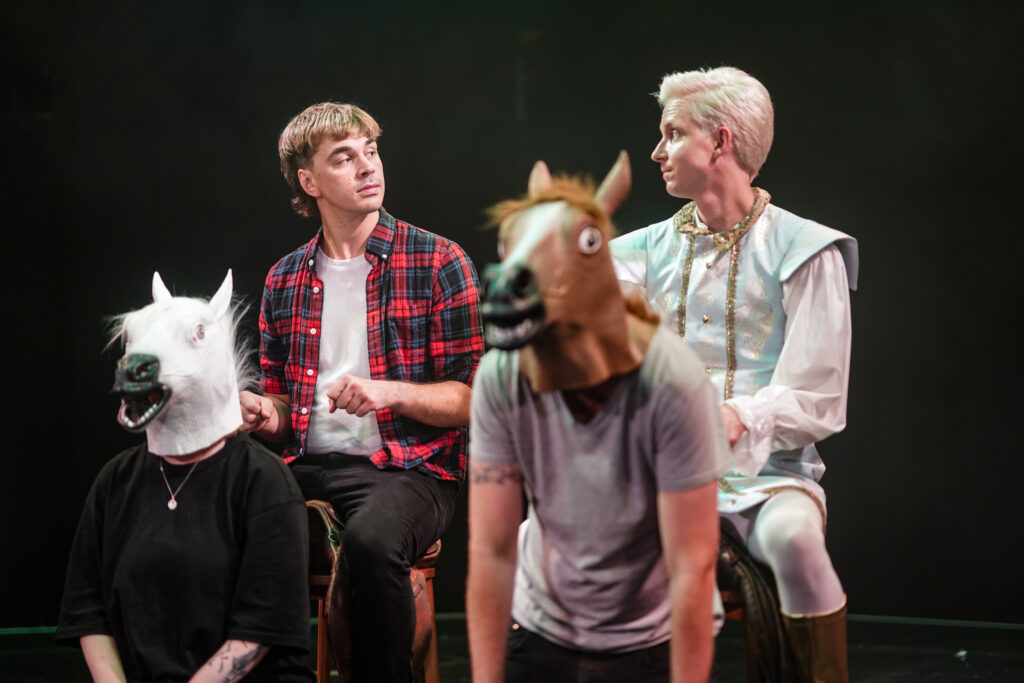
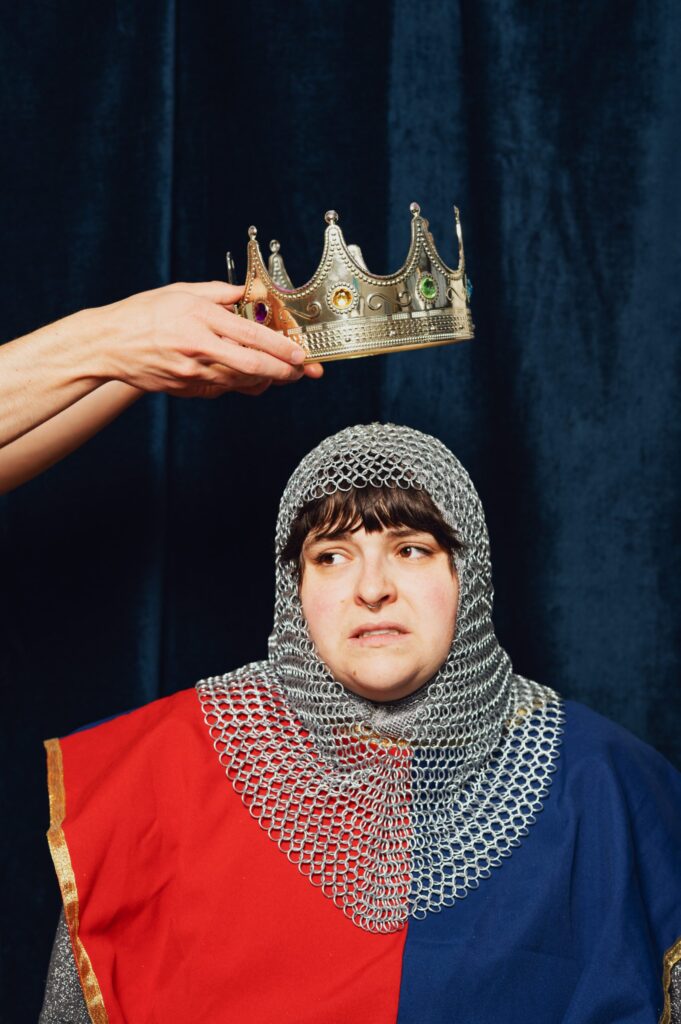
Madeleine Rowe brings back their one person production of Knight, Knight; an outlandish and hilarious tale of a Knight, his quest to become King, marry, have an heir and fight for his kingdom. However, the crux of this tale is – he’s in love with his horse.

Bizarre as it sounds, Rowe has created not only an obscenely funny narrative but conducts it with precision. Using very purposeful and calculated miming, movement and audience participation, they are able to evoke consistent giggling from us with just how bizarre but hilarious this performance is.

We only find out at the end that Rowe isn’t British at all. With this very posh and English accent, they fool us but over exaggerate and blur words, very “toff” like and this is endlessly funny.

They engage with us throughout and does brilliantly with improv on our ludicrous suggestions and off-script guidance. Their main source of comedy is repeated gestures, simple yet effective moments, such as trying and failing for a long time to scabbard their sword, or a moment of evading the crown being put on their head with surprising flexibility. This simple slapstick is so ridiculous, we only find this more and more funny as time goes on. It almost becomes overly hysterical and we love it.

Knight, Knight is a totally bonkers and fantastically executed clown show, with nothing outlandish but well constructed slapstick and repeated comedy.

Review, Count Dykula, Airlock Theatre, Ed Fringe, By Hannah Goslin

 out of 5 stars (3 / 5)

Think High School Musical meets Twilight and throw in a queer tilt to and I may present to you, Count Dykula.

With high production values, Count Dykula is the story of a loner lesbian vampire, who seeks to set the record straight for vampires everywhere and fight against the attempt to add a fluffy exterior around the monster/human dynamic, changing horror culture forever.

This threat comes from Scare University, run by a stereotypical lesbian vampire headteacher who fully leans into this with large breasts and a siren-esque facade before biting your neck. Throughout the Count’s journey, she comes across many monsters, merged with Americanised stereotypes, such as werewolf football jocks and zombie cheerleaders. These provide endless comedy and are well performed throughout, with the help of changed costumes in quick succession and great character acting.

If this description fools you however, it is not one for the children. Some of the comedy is sought in queer references, lewd and sexualised jokes and this twist on the story makes it full of laughter but also very camp and adult. We laugh at the clever stereotype merging and the content that comes with it.

The production value themselves are perfection; with well constructed costumes, props and staging, it already feels like a firmly planted production. But this doesn’t let you miss out on jokes of reduced staging at fringe; audience members are brought up to act as a mirror or a wall or help with a wrestling ring rope and this interaction adds yet another layer to the comedy.

However, for me the merging of a school aesthetic with something else felt a little twee. While the production is clearly well invested in, from the fantastic professional performances and writing, all the way down to the costumes and props, it felt like something that had been done before and, while entirely enjoyable, it felt a bit of an overused approach. They do well to combat this with satirical pop culture referencing but it still feels a little over-done.

Count Dykula is a very enjoyable and well constructed production, with clever merging of different genres and themes, it is sadly something that feels a little over saturated in theatre.

Review, Bury the Hatchet, Out Of The Forest Theatre, Ed Fringe, By Hannah Goslin

 out of 5 stars (4 / 5)

“Lizzie Borden took an axe/She gave her mother forty whacks/When she saw what she had done/She gave her father forty-one.” We do like to make nursery rhymes out of the morbid. The tale of Borden is probably most likely known because of its associated rhyme. This grotesque tale, often part of true-crime fame, has been taken by Out Of The Forest Theatre and dissected for us as a play querying Borden’s true tale.

Beginning the show, we are introduced to our three performers through song, with a folk twist. They enter the stage, foreboding, in dress to fit the era of Borden but soon break into different characters. Throughout, they will take on the multiple roles throughout the production, but break that forth wall to question the facts as well as one another on the case. They take what is written in history, and attempt to find some logic and whether Borden was really guilty or not. They drive the theatrical, creating scenes that are explicitly potential reasonings around the act, ones we have no idea that are true but with some evidence to point somewhere in those directions.

This chopping and changing of not only roles but from the scene to the debate is highly effective; with the use of basic props and changes in light and song, they are able to break those walls between the dramatic scene and analysing what is shown. With them, we begin to think about our own opinion of the case, through the truths and through the mistakes, and truly, I come out even more unsure than before, with compelling storytelling for both guilty and innocent.

They also use little bits of comedy; they bounce off one another, tiny “arguments” in the debating, or banter between friends, sometimes addressing us within this, making it endearing and does well to break down the barriers of the morbid.

The music and accompanied singing is faultless; it helps not only set the scene and embed us in the era, but it is catchy and sometimes a little creepy, adding to the emotions heightened throughout. The use of live instruments, as simple a band as this is, fills the room and only adds to the atmosphere created.

Bury The Hatchet is a well rounded production, creating an atmosphere of suspicion and sleuthing and a place for true-crime nuts to sink their teeth into.

Review, CVNT, Sophie Power, Ed Fringe, By Hannah Goslin

 out of 5 stars (5 / 5)

Disclaimer before we begin: the star rating is in no way impacted by the fact I myself ended up being pulled up to “perform” in this show. If it was, it would certainly be at a 0!

Bouffon has to be one of my favourite theatre genres. If you’re unaware of what this is, this is “clowning” but more about the taboo side of society. The aim is to highlight themes, ideas, topics and be highly satirical about this. What I love is there seems to be more of this at fringe this year, and that can only be a great thing.

CVNT, with its highly coded title (not really) is all about empowerment, of taking back the reins of your life, yet still knowing that you aren’t a perfect person, as well as the taboo around female menstruation and female anatomy. A topic that even in 2025 there is a struggle and a taboo around discussing openly.

Sophie Power immediately enters the stage after creating slow anticipation; singing slowly “Don’t you want me baby” as she plays with the nearest audience from behind a curtain, she begins to add a level of fear and nervousness amongst us. Revealing herself, in true bouffon form, she is dressed head to toe in shades of red and pink tulle, silky gloves with sharp nails (reminiscent of HIM from the Powerpuff Girls) with only her face on display that contorts and plays with us. This is somehow threatening but also inviting and creates much confusion.

Audience participation is at its top in this – we laugh, we are shocked, we are surprised, we are confused all in unison but somehow, Power creates a really powerful union within us. We root for each other but also laugh. Some participation is vulnerability and taking that power back, some is an anatomy lesson, some are “party games” and, in my case, the chance to blow the dust off my own bouffon days (and poorly may I add!). But for once, no one is reluctant. Despite this foreboding figure, we trust them and this helps in luring us into the hilarious, the shocking, the taboo and we accept that fully.

CVNT is a stroke of absolute genius in bouffon/clowning but isn’t for the faint hearted or the meek. Prepare to be fully thrown into the obscene, the madness, the chaotic but laugh so unbelievably hard for the entire thing.

Review, How To Win Against History, Francesca Moody Productions and Bristol Old Vic with Underbelly, Ed Fringe, By Hannah Goslin

 out of 5 stars (5 / 5)

I’m coming right out the bat and making a bold statement: this might be one of, if not THE, best thing I have seen at Fringe this year. 

Another statement: musicals do not tend to be my thing. There are only really specific ones that catch my attention and that likely does not mean much in terms of the real greatness of them. However, when they do catch my attention, I think of them as very special – How To Win Against History is bar far one of these.

Based on the true story of Henry Cyril Paget, an aristocrat partially erased from history, this company take on this in a musical, camp and spectacular way. They tell the story of Paget, his frivolous spending of his money and tragic demise. While the narrative sounds pretty deep, this musical blends perfectly the mixture of fun and humour with heart string pulling.

This production is already fully fledged – set in the main venue at Underbelly, it already has the spectacular expanse with a full band, glittering staging and lights, and a bum on every seat. While the audience is huge, all the performers manage to make a connection with every single one of us; we feel included, safe and part of the show. The characters are very likeable, with Paget particularly being extremely personable. And there are no small parts here; from the main character to the drummer or trombone player, they are all 100% engaged with the action, reacting and being involved every step of the way. This is a true and equal ensemble.

The production is wholly camp and fabulous; engaging with the concept of gender roles and flexibility with this, we are dazzled by sparkling and beautiful coloured outfits, once again, being all things already west end stage professional. And the performers themselves are so much fun and humorous – there isn’t one part (well, apart from the darker points of the story) when we are not giggling or laughing out loud, from purposeful jokes and slapstick, to the subtle changes in facial expressions or engagement, everything is so perfectly done.

And finally, the music is wonderful and catchy – so beautifully performed, the voices and music are completely on point, ringing out across the expanse of the space and so easily could be the start of an album or a cult musical theatre following.

How To Win Against History is absolute perfection. It is not only a barrel of laughs, but so perfectly created and executed that it’s a wonder that it isn’t already the next big thing on the West End Stage.

Review, Beth Knight: Who Told You To Be Small, Ed Fringe, By Hannah Goslin

 out of 5 stars (2 / 5)

If you told me this was meant to be a comedy show, I would have not believed you. From the marketing down to the show itself, my impression was this was meant to be a serious body positive production but I found out to be wrong in this assumption. 

Beth Knight, artist meets tech guru meets now comedy hopeful, brings her story of body positivity and seeks to deliver life changing art to her audiences. We go through her life, from her upbringing through adult life and her inspiration of a painting at the National Gallery. The underlying theme begins with money and this is when we see her change of tact to working in tech, obtaining her central London flat, living alone and living the best lift. But something is missing, and in between this, she seeks back to her original passion: art. 

While this performance was very interesting, marketing this as a comedy did not feel correct. It felt a little like a TED talk on art or life coaching, and therefore lacked any performative comedy moments but more those easy and natural moments found in a speech or presentation. Knight is very personable throughout and we like her, even if she seems very nervous in her delivery. It’s clear that she has true talent in art, shown via the screen behind as a visual aid and is vulnerable and honest with us throughout, which is brave and admirable. 

Knight’s artwork is beautiful and grotesque and very much shows her extreme talent and her work to accept herself and look at the world in a vulnerable position. Presenting this to us was so interesting and endearing, and her original art work of giant dogs in places was fun and engaging. However, as a comedy performance, it sadly lacked the comedy bits and left us wanting more than an art history presentation.

Review, Miss Brexit, Maria Who?, Ed Fringe, By Hannah Goslin

 out of 5 stars (3 / 5)

Think highly British, camp, Miss Congeniality style show case and you get Miss Brexit.

Maria Who? have approached the vote to leave in play form, bringing the liberal view point (well placed in an arts festival) to the forefront, by using comedy and good old fashioned British take-the-mick humour. We, as active participants, join the performers to decide the winner of the contestants to be allowed to stay in the country. We meet four contestants from varying countries, as they try to assimilate in contest-style scenes to British customs, tell us their tales of why they came to the UK and their experiences, and based on this, we make the tough decision who to stay and who to deport. 

Miss Brexit is highly satirical, with contests such as answering genuine questions on the citizenship test which are hard even for a born and bred British person. They provide sarcastic views on British stereotypes such as pouring tea correctly and we are forced to not only agree with how ridiculous the situation is but also how ridiculous we are as a country. 

Our compere is full of energy, quick off the mark with great improv skills and provides much comedy in their performance. Our contestants are notably performantive (think pageant performer style) but at times this feels too hammed up and a bit over the top though their improv skills with us audience members is top notch. 

The narratives are very clever and do well to evoke emotion and complicated feelings, whether it be a positive or a negative story. But they also show varying degrees and moments of resonation; moving to London alone, not only for those who come outside the UK but inside as well is easy to recognise, with the high rental rate and probability of moving in with 5 others to keep the rent down. 

Accompanying the show is awesome background music, giving an impression of Rupaul’s drag race meets Miss Congeniality, changing to fit the character and story of the time, evoking a feeling of their culture. The screen behind helps set scenes, with boarding cards when deported to the logo of the contest. 

Miss Brexit is a unique and interesting take on political and social commentary but felt some distance from a higher starred production.