
All posts by Roger Barrington

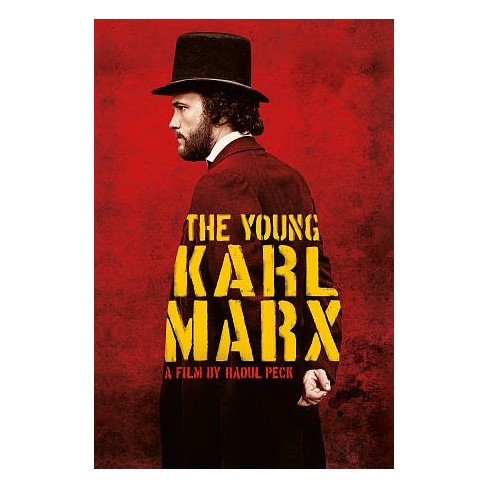
Review “The Young Karl Marx” at Chapter Cinema 1 by Roger Barrington

Directed by Raoul Peck August Diehl as Karl Marx Stefan Konarske as Friedrich Engels


 out of 5 stars (4 / 5)


This year marks the the bicentennial anniversary of the birth of Karl Mark, and to mark it, Haitian director Raoul Peck has made a film to commemorate this auspicious event.

When many of us think of Marx, (and I count myself among them), we have some abstract idea of a granite type entity, largely due to his tomb at Highgate Cemetery or his enormous and unfinished Magnus Opus, “Das Kapital”. Unfinished because Marx believed that the subject matter was in a permanent state of evolution. This film introduces us to the human side of Marx.

We are introduced to Marx’s family – his wife Jenny von Westphalen, (Vicky Krieps),  who came from an aristocratic Prussian family, and gave everything up to be with Marx and support his political and philosophical agendas.

In contrast, Friedrich Engels was the son of a wealthy Manchester textile manufacturer, and witnessed the hardships of the workers at first hand. which he wrote about in “The Condition of the Working Class in England” (1845), a work that Marx greatly admired. Engels had a lifelong romantic relationship with Mary Burns, (  Hannah Steele), of which little is known, other than she probably introduced Engels to inside information about the suffering of the working class on which he wrote about.
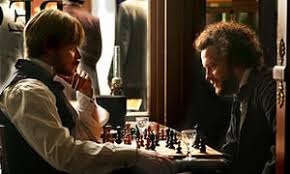
The two couples juxtaposed represent a kind of counterbalance when you take into consideration their backgrounds. Marx and his family live in poverty, finding it difficult to stay in one country for a length of time due to his radical political ideas.

There is,unavoidably, quite a lot of political and philosophical dialogue in this film. The stunning opening scene which shows a group of peasants, anxiously gathering up dead wood from the forest ground, before being the recipients of a baton charged hussars patrol, leads to a voiceover on Marx’s ideas about class struggles. “To gather green wood, one must rip it violently from the living tree. Yet gathering dead wood removes nothing from the property. Only what is already separated is removed from the property. Despite this essential difference, you call both acts theft and punish them as such. Montesquieu names two kinds of corruption: One when the people do not observe the laws. The other when the laws corrupt them. You have erased the difference between theft and gathering. But you are wrong to believe it is in your interest. The people see the punishment, but not the crime. And, as they do not see a crime…when they are punished, you should fear them, for they will take revenge.”

Marx fiery personality shows him to be an inspiring orator but intellectual bully and in contrast to the more gentler Wilhelm Weitling, the tailor/political activist who as ultimately edged out of The League of the Just, the political Utopian organisation that reorganised into the Communist League under Marx and Emngel’s influence.

In a way, the film is a buddy movie between Marx and Engels. It shows that Marx couldn’t have advanced into the powerhouse he is today without Engel’s assistance – especially his financial help.
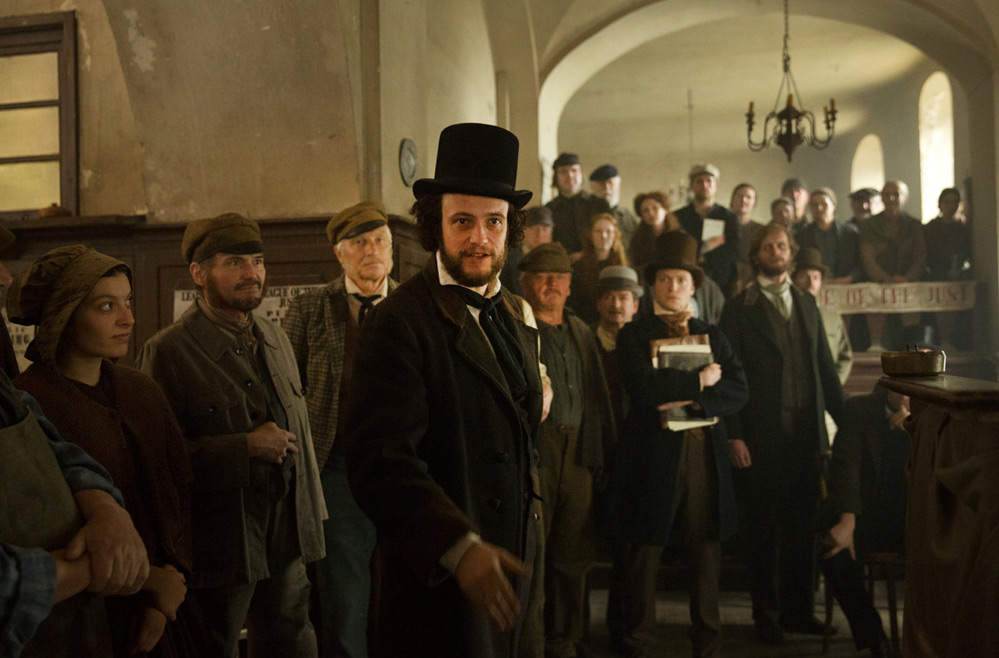


The period covered is relatively small, from 1843 to 1848, when Marx and Engels published what is believed by many to be the most influential literary work of the nineteenth century – “The Communist Manifesto”. It’s immortal first line, ” A spectre is haunting Europe — the spectre of communism. All the powers of old Europe have entered into a holy alliance to exorcise this spectre: Pope and Tsar, Metternich and Guizot, French Radicals and German police-spies”.

Karl Marx is vividly brought to life by German actor, August Diehl and his countryman Stefan Konarske portrays Engels as a quieter, more sensitive but equally determined brother in arms. Good support is provided by Luxembourg actress Vicky Krieps as Jenny and British actress Hannah Steele as Mary.

Director  Raoul Peck, working with a pan-European cast and crew, manages to make the film look more lavish than it should do, and the sincerity of the work is unquestionable. You can’t help to be inspired by the energy and commitment shown by these young radicals of a century and a half ago, and it made me wonder whether we will see their like again in the future. Everything today seems so anodyne and people are afraid to speak their minds either due to retribution or fear of political correctness. So nothing much changes and the beneficiaries of this maintenance of the status quo is the bourgeoisie that should remind us that the class struggle is still present and as vital now as it was during Marx and Engels time.

“The Young Karl Marx” is an earnest didactic film, that has enough human interest within it to make it accessible and enjoyable to many cinema-goers.

I shall finish off by quoting Wilhelm Weitling in a line taken directly from the film. “Critique devours everything that exists. And when nothing is left, it devours itself”. On that note, I had better end.

Country: France, Germany Gelgium

Language: German, French, English with English subtitles where needed.

Duration: 118 minutes

It plays at Chapter in Cardiff until 5th July.

https://www.chapter.org/young-karl-marx-ctba

Roger Barrington



Review “Jeune Femme” aka “Montparnasse Bienvenue” watched at Chapter Cinema 1 by Roger Barrington

Directed by Léonor Serraille Laetitia Dosch as Paula


 out of 5 stars (4.5 / 5)


Leonor Serraille’s terrific debut film, “Jeune Femme” also known as “Montparnasse Bienvenue” was shown at the 2017 Cannes Film Festival where it won the Camera D’Or award for best first feature.

The titles is a little incongruous in either of its two version. At 31, Paula, the heroine of the story is hardly a young girl. Montparnasse Bienvenue is the name of one of the busiest Metro stations in the Paris underground where a number of lines converge. However, nothing of note in the film happens here.

Maybe “Jeune Girl” is a reflection of Paula’s sometimes immature actions. And Montparnasse Bienvenue(Montparnasse Welcome (you) can be considered ironic, because there is little in terms of cinematography that is particularly welcoming in this film. In fact, for a film made in Paris, the director manages to make it look like any other inner city, with its functionality and ugliness. This represents Paula’s impression of the French capital which she dislikes. “I think Paris is a city that doesn’t like people” .  Or possibly, “Montparnasse Bienvenue” with its confusing convergence of metro lines represents how complicated are everyday life is in the 21st century.

The film starts in a ferocious manner where we see Paula headbutting an apartment door in response to her requests for entry being disregarded.

Having injured her head, she attends hospital, and in a rare lengthy scene, we learn that she was trying to gain entry into her lover of ten year’s flat who has obviously wanted to end the relationship. Returning after this event to the flat she notices her ex-lover’s cat and decides to catnap it. Clutching this white furry ball to her chest, we witness Paula’s attempt to rebuild her life and the encounters she has along the way.


In a way, it is an anti-existential film. For Paula lives in the moment paying total disregard for consequences of her actions. Seeking a place to lay her head, (and the cat’s), she calls upon a friend who is prepared to put her up. However, the heavily pregnant friend makes a cutting remark about the cat, prompting Paula to ask whether she thinks she will make a fit mother. So, she and cat get promptly kicked out.

There is a very clever scene at Montparnasse Cemetery, where Paula finds an open tomb to shelter her cat from the rain. I don’t think it is a coincidence that at this cemetery you have buried John-Paul Sarte and his lover Simone de Beauvoir, probably the two greatest existentialists of the twentieth century. So living in the moment, she finds an open tomb a useful place to satisfy her needs at that time, whereas Sarte and de Beauvoir were useless remains – a remnant of the past.

She meets a girl who mistakes her for an old friend due to Paula’s heterochromia iridis – different coloured eyes. Excited by this, the girl takes her home to stay but Paula doesn’t think to tell her that in fact she wasn’t that friend, and this is only learned later on.


Looking for work, she takes on a job as a home help and childminder for a dance company director. At first, the little girl is serious and guarded, so with Paula being her inimitable self, it almost seems like role reversal. But gradually  the girl takes to Paula and they establish a relationship which appears to open up a new world for the strictly brought up child. Whether the reason is that the mother is jealous of Paula’s easygoing relationship with her daughter, or something else, she decides to look for a replacement.

Paula also takes a ship in a Knicker Bar section of a department store. It is only a temporary job, (but that isn’t going to phase Paula). and she takes to it well. She establishes a friendly relationship with an Afro French security guard for the mall whether the store is located. He is a steady guy who you think might act as a rudder for Paula’s spontaneous lifestyle.

Eventually we are introduced to Paula’s ex Joachim, (Grégoire Monsaingeon), who is a professor and intellectual, in contrast to Paula, who by her own admission states that she is not very clever. Joachim is older than Paula and it would seem that she may be attracted to older men due to her father being missing in her life. Joachim  now wants to get back together with Paula, and this desire is intensified when he learns that Paula is pregnant with his child. He comes across as being a supercilious and condescending man who comes close to sexually assaulting Paula when she turns down his advances.

Paula is estranged from her mother – we don’t know the reason other than her mother complains that she is always leaving. She literally pushes her away and when Paula breaks into her mother’s home, there is a poignant scene when she is clinging on to the banister with both arms and legs as her mother tries to push her out.  However, there does seem to be some acceptance after this on the part of the mother, but we don’t know how long this will last.

Along the way, the director provides some social comment. At the knicker bar where Paula works, each girl has to be dress uniformly and provide a branded look in their personal appearance. Therefore they walk around the store like mindless clones. During a lunch break when she is talking to her friend, Ousmane, the security guy, she is reminded in her ear-piece that breaks are for only 30 minutes not 35, reminding us of the “Big Brother” environment that often plagues the modern workplace. Ousmane has a degree in economics but is working in security. Maybe this is down to his ethnic origin.


The film is a triumph for Laetitia Dosch as Paula. She is in every scene of the movie and gives a totally uninhibited and honest portrayal of a woman who just gets on with her life and deals with problematic situations as they arise without guarding against them.

Through the skill of director   Léonor Serraille, we view the movie in the moment also. It is very unusual in that way – it immerses you into Paula’s lifestyle which typifies modern living – especially in the great metropoles of the world. I’m tempted to say that it is a film about alienation and isolation – there is an early references to Barentsburg, a settlement on the Norwegian island of Svalbard, (formerly Spitzbergen) and located north of the Artic Circle. You can’t get much more isolated than that.  Alienation and isolation are a factor, but I think  this film is more a testament of Paula’s ability to overcome her difficulties and it leaves a surprisingly uplifting effect on you.

This movie won’t be to everyone’s taste, but if you like offbeat comedy-drama, in the classic French New Wave style, then I can recommend it unreservedly.

“Jeune Femme” has finished its short run at Chapter Cinema 1, but can still be found at selected locations in the U.K.

County: France

Language: French with English subtitles

Duration: 97 minutes

Cert. 15 for mild nudity and occasional strong language and sexual threat.


Roger Barrington


Review: An Officer and a Gentleman – The Musical at the WMC by Roger Barrington

Emma Williams as Paula Pokrifki Jonny Fines as Zack Mayo Ray Shell as Emil Foley Ian Mcintosh as Sid Worley Jessica Daley as Lynette Pomeroy Directed by Nikolai Foster


 out of 5 stars (3 / 5)


Verve Leicester’s version of the 1982  double Oscar winning film “An Officer and  a Gentleman” is the second attempt to adapt this iconic movie into a musical. The first premiered in Australia in 2012 and bombed out of sight. So can we expect more from this improved 2018 version?

Still set in 1982, the story seems a little dated nowadays with gender issues much more under the spotlight. It is essentially a Cinderella storyline set in Pensacola, Florida, the location of the first Naval Aviation Station in the U.S. military set up in 1914. Since that time, countless number of naval aviators have been trained here. Rather like my home town of Brecon, which also has a, (although diminishing), military presence, there is an uneasy relationship between army personnel stationed there and the local inhabitants. Writer Douglas Day Stewart trained at this base for service during the Vietnam War so his story is based upon his own experiences.

Pensacola, or at least the part around the naval base is depicted as a depressed area where local girls dream of capturing the heart of a trainee officer, in order to raise them from their station.

Friends Paula and Lynette are two of these girls, although it turns out have different agendas. The story shows the courtship of the two officer candidates Zack and Sid, who have to endure a tough twelve-week course to determine whether they are officer material.


You’re in the navy now


The musical version follows the basic story-line of the movie interspersed with a number of well known hits which generally have a slight connection with the action, that helps to keep the show within its historical context.

Early on in the show, a gang of girls working in a mundane job sing, “It’s a Man’s World” and the development of the plot tends to emphasise this.

Emma Williams as Paula is the pick of the singers on display.

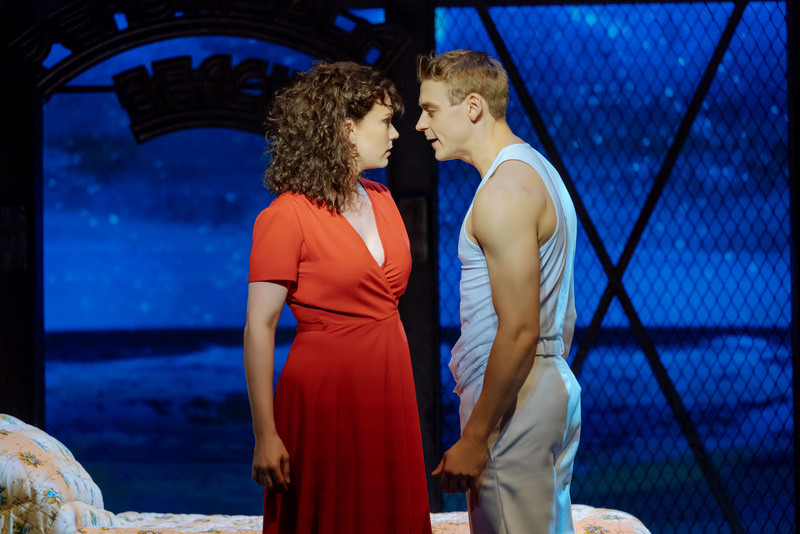
Emma Williams as Paula and Jonny Fines as Zack


Her strong and versatile voice is highlighted in her duet with her mother Esther, (Rachel Stanley), in “Don’t Cry Out Loud” – one of the highlights of the show. Other 80’s pop and rock standards, ” St. Elmo’s Fire”, “Livin’ on a Prayer”, “The Final Countdown”, “On the Wings of Love” and altogether a total of 22 songs are present to entertain you. Most are sung well enough, although sometimes a little stridently, and they are accompanied by recordings of a commissioned band.

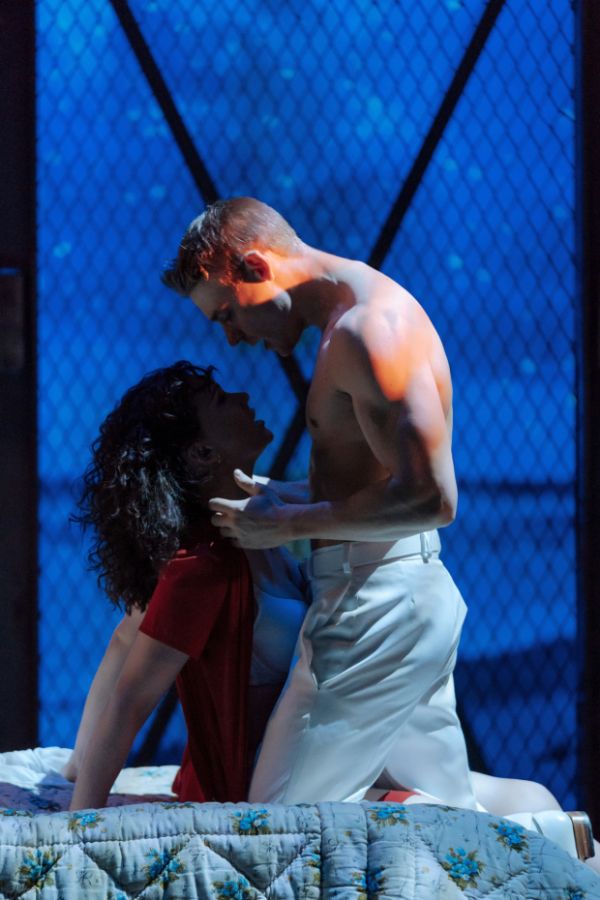
Michael Taylor’s set design and Ben Cracknell’s Lighting are of a high standard. With a backdrop of video projections, it provides a filmic effect. The love scene against a backdrop of crashing waves rushing on to Pensacola Beach is memorable.


The performance was well received and I think this was influenced by the final scene, which director Nikolai Foster judges perfectly by not going too over the top. This is the scene where Richard Gere playing Zack was at odds with director Taylor Hackford for being too overly romantic in contrast to the social deprivation and class issues that preceded it. He wanted a different more realistic ending but lost out.

An Officer and  Gentleman – The Musical isn’t a classic, but it did get audience members around me singing and moving in their seats to the motion of the music and was rapturously received.

If your bag is 80’s music, and a familiar story-line, then you will love this show.

It lasts around 2 and a half hours including a 20 minute interval.

There is strong language throughout and sexual references and scenes.

It runs until 30th June

https://www.wmc.org.uk/Productions/2018-2019/DonaldGordonTheatre/AnOfficerandaGentleman/

Cardiff marks the first touring location for this production. For further details of tour dates

http://officerandagentlemanmusical.com/book


Roger Barrington


Review “Sherlock Holmes – The Final Curtain” at The New Theatre, Cardiff by Roger Barrington

Theatre Royal Bath Dress Rehearsal April 2018
Sherlock Holmes The Final Curtain
By Simon Reade after Arthur Conan Doyle
Director Ð David Grindley Designer Ð Jonathan Fensom
Lighting Ð Jason Taylor Sound Ð Gregory Clarke
Sherlock Holmes/Robert Powell Mary Watson/Liza Goddard
Mycroft Holmes/Roy Sampson Dr Watson/Timothy Knightley
Miss Hudson/Anna O’Grady Officer Newman/Lewis Collier
Other Parts Daniel Cech-Lucas Peter Cadden
Peter Yapp Louise Templeton


 out of 5 stars (1.5 / 5)


The previous occasion I attended The New Theatre in Cardiff, Jess Conrad was donning his “amazing  technicoloured dreamcoat”. The year was 1978, so with great anticipation, I returned to Cardiff’s well known variety theatre. Opened in 1906, the average height of British men was 4 inches shorter than today, which meant that the Dress Circle seat that I occupied for the performance under review, was decidedly less cramped in Edwardian then what I had to endure.

So, not off to an auspicious start then. I was attracted to this production because I have a life long interest in the famous consulting detective.

The action takes place in 1921 and 1922  and we learn that Sherlock was born on Twelfth Night 1854, which makes him 67-68. In a declining mental and physical state his isolated existence at his Sussex home is interrupted by the discovery of a woman, dressed in male attire being found on his own private beach.  Over the next 100 minutes, we witness Sherlock piecing together the evidence until he unmasks the killer towards the end of the show.

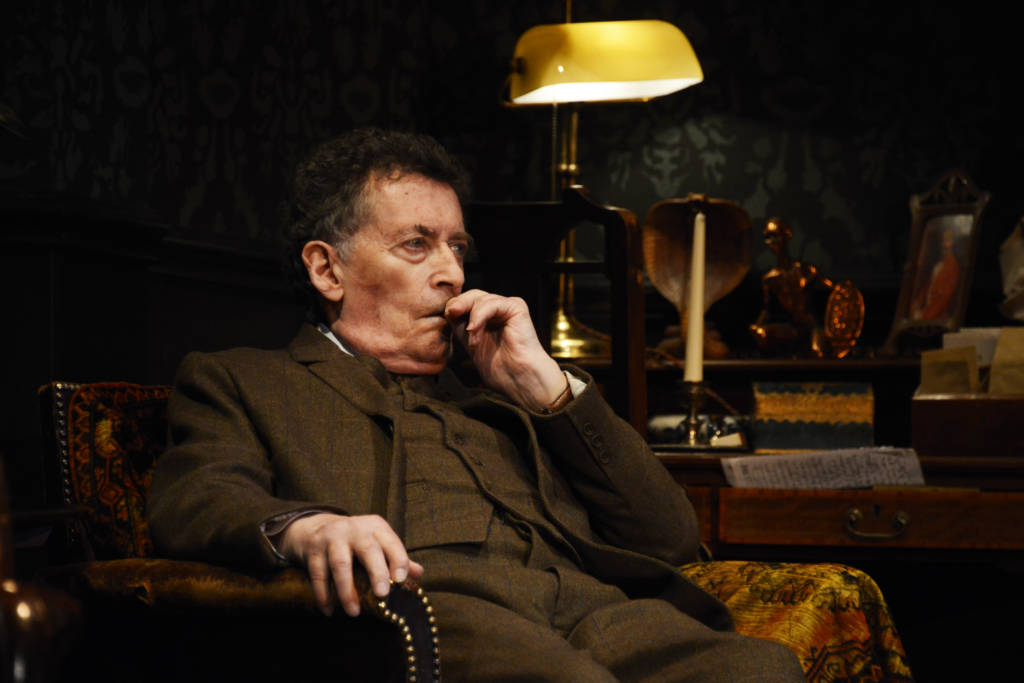
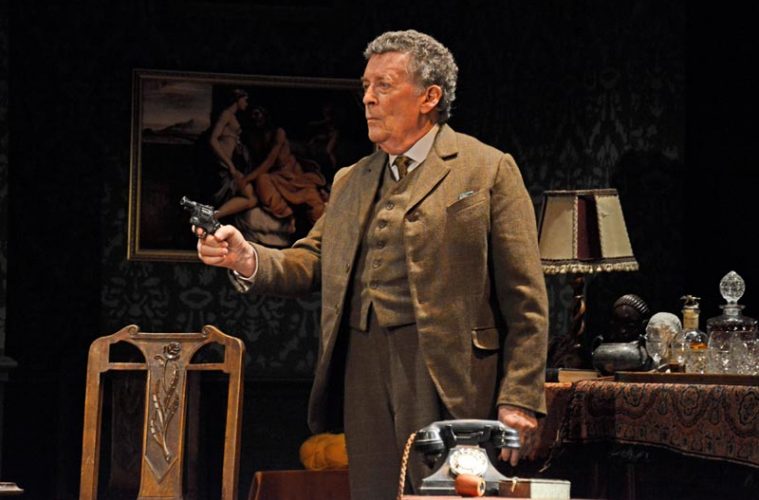
Sherlock Holmes is played by Robert Powell, a solid actor whose acting peaked at the summit of Mount Calvary in Franco Zefferelli’s 1977 mini-series, “Jesus of Nazareth”.

You don’t mess with our Sherlock!


Powell, excellent in this production, is much more believable portraying Jesus than he is Sherlock Holmes. Whether it is Basil Rathbone in the 1940’s, Jeremy Brett in the 80’s, Benedict Cumberbatch in the past ten years and Sir Ian McKellan in the 2015 film, “Mr Holmes”, there is a consistency in how our hero is depicted.  Sharp intelligence, a kind of nervous inspired energy, a man of unique intellectual ability and impeccable instinct, I just don’t see Robert Powell being able to achieve that within his acting range.  A great voice, I concede, but, even in Sherlock’s dotage, as Sir Ian McKellan was able to show, we must believe that Holmes is still an exceptional sleuth.

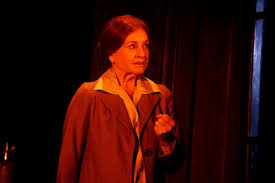
Liza Goddard as John Watson’s wife Mary is also miscast.


Liza Goddard as Dr. Watson’s other half Mary


I have seen Ms Goddard on stage before in a dramatic role and I’m not overly convinced that her talents lie in this direction. The Final Curtain is a comedy thriller, but, sadly the writing doesn’t allow Mary to share many of the humerous lines, and that is a shame, because Liza Goddard is at her best in comedic roles. Instead she comes across as a Dame Judi Dench on Xanax.

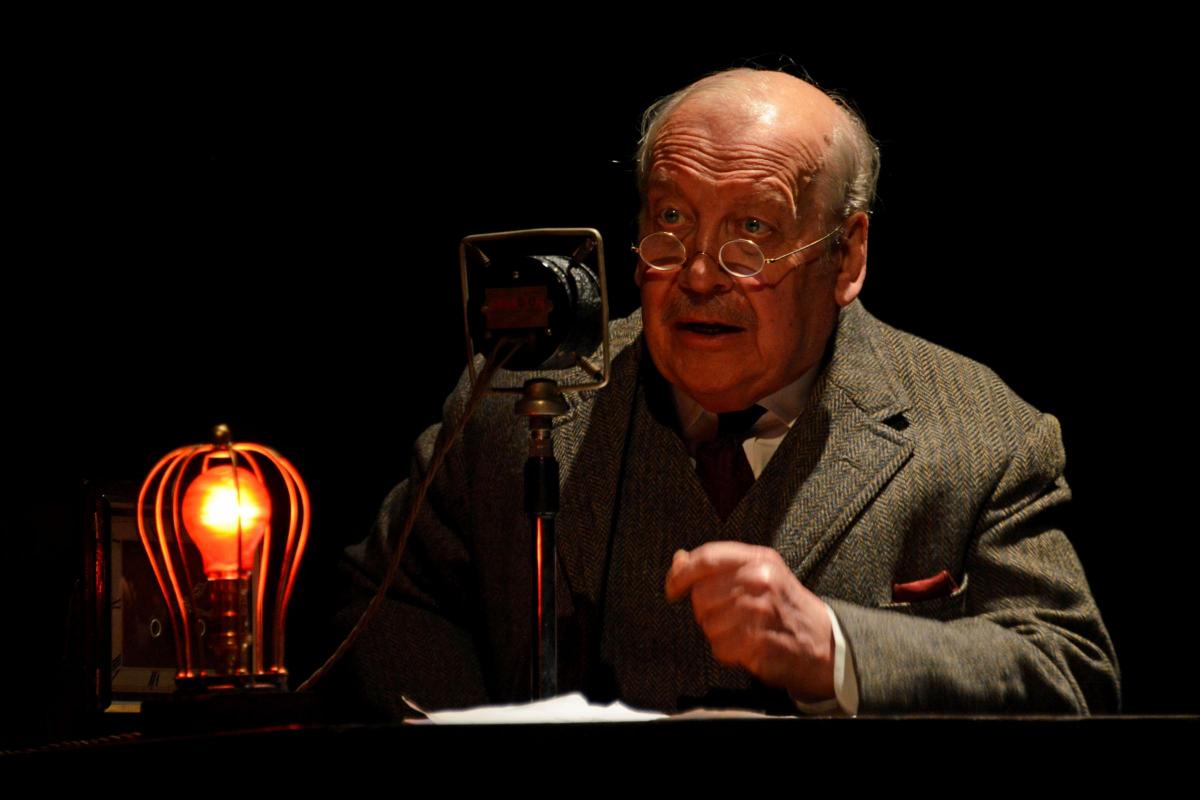
Timothy Knightly as Dr. Watson fares a little better.

Timothy Knightly as Dr. Watson broadcasting his memoirs of the casebook of Sherlock Holmes on the BBC


I last saw this actor in the fantastic 1994 revival of Arnold Wesker’s “The Kitchen” directed by Stephen Daldry. I attended the first night and it remains one of the most memorable productions I have ever seen. This production could do with some of the sheer excitement and tension that “The Kitchen” possessed.

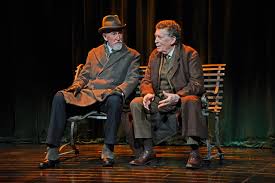
Roy Sampson plays Mycroft Holmes.


Mycroft Holmes (Roy Sampson” in deep discussion with bother Sherlock probably about why he needs to be in this play


Other than a comment about sibling relationship where he is implied but not present, there doesn’t appear to be any reason why he appears in this story other than padding it out a little.

Anna O’Grady plays Miss Hudson – get it? Daughter of the famous Mrs Hudson, housekeeper of 221B Baker Street, who, as this story is set in 1921, based upon the youthful appearance of Miss Hudson, her mother must have set some kind of record for giving birth. And as there is never a mention of a Mr Hudson – well the mind boggles?Miss Hudson is the breezily cheerful stereotypical Cockney maid.

Lewis Collier plays Detective Inspector Newman, looking suspiciously young for this rank for 1921. It is a totally nondescript character and the actor has little to work with.

Oh and there is a tramp played by Peter Brollow, which is fair enough as long as you don’t ever undertake crossword puzzles.

The play is written by Simon Reade,  has an excellent pedigree of credits. Recently he wrote the screenplay for the film version of R.C. Sherriff’s novel “Journey’s End”. and has also worked with The Theatre Royal Bath, (whose production this is), notably on “A Room with a View” an adaptation of E.M. Forster’s exquisite novel. I don’t know what went wrong here. The dialogue is largely anodyne, bordering on the soporific, which manages to convey no chemistry between Holmes and Watson. The exception being the final scene where they are planning their future together, which is not bad at all.

There are some amusing lines, but the story provides no thrills and is so predictable, I was beginning to feel that I had  read the story previously – I hadn’t. I had experienced greater excitement on a wet afternoon in Cwmbach.

And the final scene is totally superfluous and if you think about it, totally ridiculous.

The effects are nothing special and scene changes are carried out in an untidy and clumsy way of a curtain moving slowly back and for across the stage.

Sets other than 221b Baker Street are sparse with only limited props.

This production lies very much in the commodity camp of theatre. The House was almost full, and plays such as this do have a place in the dramatic canon, but I have seen this genre done much better over the years. If you are looking for theatre which challenges you, you would be better off staying at home taking on your pet Shih Tzu at a game of chess.

Sherlock Holmes – The Final Curtain – well, one can only dream.

The play runs until Saturday 30th June 2018 before moving on to Leicester’s Curve next week.

The play is suitable to all.

Runs 110 minutes including a 20 minute interval.

Tour dates

https://www.theatreroyal.org.uk/production/sherlock-holmes-the-final-curtain/

New Theatre Bookings

http://www.newtheatrecardiff.co.uk/what’s-on/sherlock-holmes-the-final-curtain/


Roger Barrington