
‘Under Milk Wood’ is a challenge. It’s tackled regularly in Wales because there are not many plays that focus forensically on everyday Welsh life and, as far as I know, none written poetically. It is an extraordinary piece of writing, but this makes for a very unconventional play. Dylan Thomas sets the work somewhere that, on the face of it, like so many small towns, has nothing of apparent significance to offer the outside world – bugger all, in fact – but by the sheer pressure of his language transforms it into something remarkable and unforgettable. It’s as if he had followed Keats’ instruction to ‘load every rift with ore’ to the letter.
But that’s the problem. We are not used to modern-day poetic drama. Even if Llareggub (or Llaregyb – the production uses the town’s Welsh name) floats somewhere in its own particular mid-twentieth century time zone, the people of the town and their activities are the stuff of common or garden reality, not of fantasy or historical legend. To hear their everyday conversations and monologues shot through with a welter of idiom, word play jingles, sly metaphors and over-the-top imagery, is quite an experience. You have to listen carefully and take in what is being said to appreciate what is going on.
Poetry enriches the moment. It creates a charged atmosphere, and it builds tension via suggestions and reflections. Poetic drama does not require much in the way of mystery and suspense, but it can deliver within some very tight rules. ‘Under Milk Wood’ conforms to some of the classic restrictions. Its action more or less happens in one place and is described and discussed by two narrators. Everything takes place in the course of twenty-four hours, one Spring day. But you have to really go at Thomas’ text to turn it into a play works for a contemporary theatre audience.
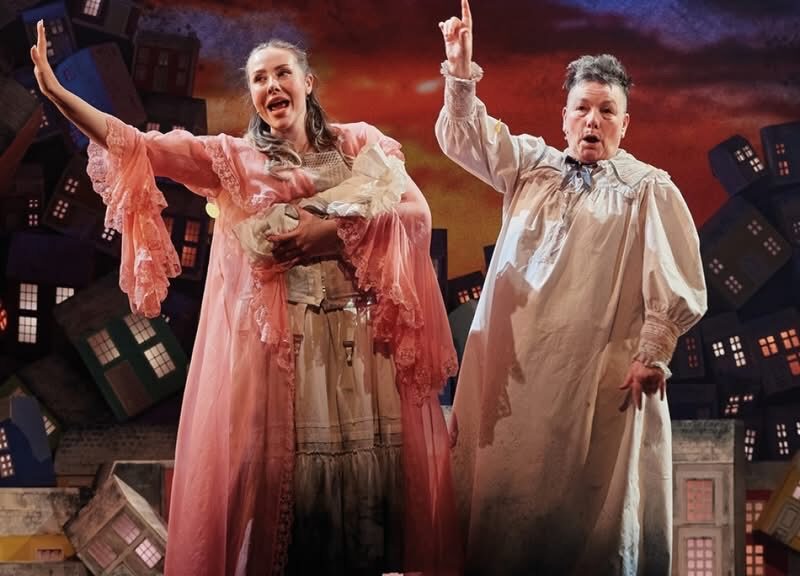
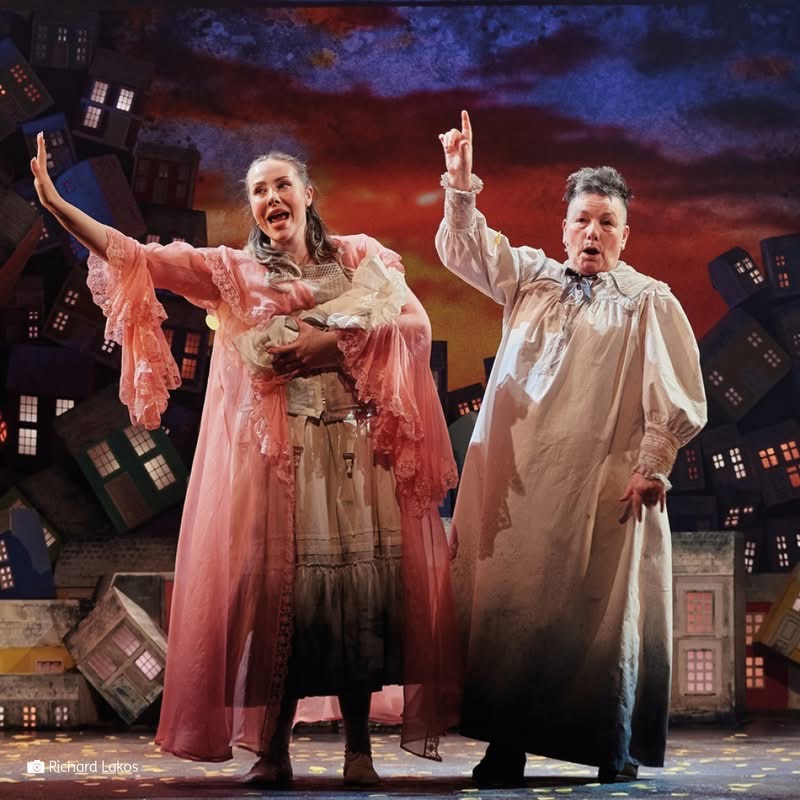
Kate Wasserberg directing and Hayley Grindle designing adopt an approach which changes what Thomas wrote specifically for the radio into what looks like a kind of pop-up adult graphic novel, full of colour, surprise and ingenuity. All the episodes of a soap are compressed here into a reality show. The sweeping narration is delivered by all the members of the cast, meaning a variety of voices and accents take us into the heart of an average small community.
The production is given considerable muscle by performing members of Craidd, a Welsh collective which includes deaf, disabled and neurodivergent artists. Although there are only eleven of them, they create over forty characters. These characters are necessarily only sketched in but they, in turn, evoke the diversity of a whole community. Of course, this suggestive process is helped in this by names like Mrs Willy Nilly, Organ Morgan, Evans the Death, Gossamer Benyon, Nogood Boyo and Sinbad Sailors.
The cast perform the interconnected sketches that build up the circumstances of these characters with energy and wit in an even collaboration, each briefly coming centre stage. No one single performer hogs the limelight because no single story line is given preference. The only exception to this principle are the stand-out singers, whose solos in the second half add another dimension to the atmosphere.
There is no resolution to the various scenarios, no startling denouement to make a point, no deus ex machina. We know Miss Myfanwy Price and Mr Mog Edwards will never consummate their affair. Sinbad dotes on Gossamer Benyon, but she will never gobble him up. For all his plotting, Mr Pugh will never murder Mrs Pugh. Cherry Owen will continue coming home drunk, as his wife loves him drunk or sober and Butcher Benyon will continue tormenting his sensitive wife who believes his little lies. Mrs Ogmore Pritchard, twice widowed, won’t have a gentleman in from Builth Wells, preferring instead to live with the ghosts of her former husbands.
The only conclusion to what goes on in Llareggub (or Llaregyb) is night falling yet again on a kind of melancholy in which Capt Cat’s Rosie Probert is dead – like Polly Garter’s Little Willie Wee, who took her on his knee. In the dusk, the words ‘Thou Shalt Not’ speak from the wall while Lord Cut-Glass, in his kitchen full of time, listens to the voices of his sixty-six clocks, one for each year of his loony age.
Whilst there are frequent references throughout to social issues – ‘There’s a nasty lot live here when you come to think’ – and truisms ‘like Men are brutes on the quiet’ occur regularly, there’s no dramatic argument, no social or political message to get across other than,
We are not wholly bad or good
Who live our lives under Milk Wood
Dylan Thomas intended to paint an animated portrait of a place without ever judging it Theatr Clwyd’s production is faithful to his intentions in its own way. I don’t know how many stars to give it but it’s well worth seeing.