
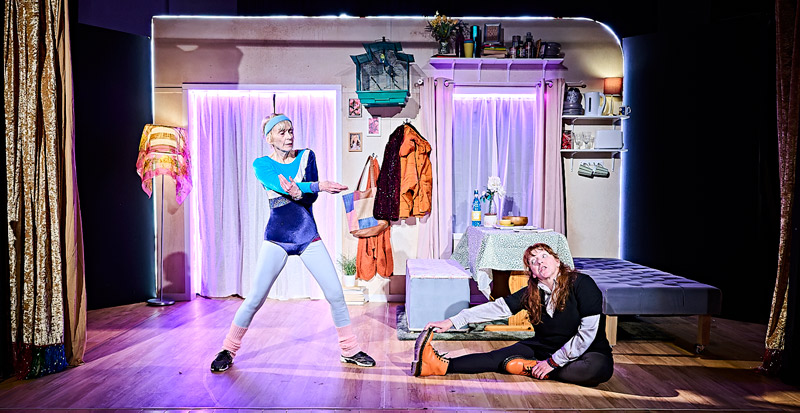
As it says on their website, TRIONGL is a company made up of three founding members, Valmai Jones, Rebecca Knowles and Rebecca Smith-Williams. The members work collaboratively to devise new pieces of theatre that engage with socially relevant themes with joyful scrutiny. The company is Cardiff based and works in both the Welsh and English language as appropriate.
‘Is There Anybody Out There?’ is a devised piece that runs for about an hour and a half. It is performed without an interval. The actors mainly speak in English, frequently addressing the audience directly, but there are a lot of exchanges in Welsh. These exchanges are translated simultaneously into English and are shown on a screen.
The subject of ITAOT is life after death or, more precisely, the spiritualist activity of getting in touch with those who have died by asking them to speak. The subject is treated with respectful irony, as much as ‘joyful scrutiny’, so the tone of the performance is comic. No attempt is made to scare the audience with things that go bump in the night.
The subject matter looks back to a time when it was common enough for audiences to go out to watch mediums ostensibly make contact with the dead. Unfortunately, Angela, our hostess for the evening, is a stand-in who does not believe and who only got involved in the spiritualism business because she was a member of a youth theatre and enjoys acting. To her astonishment, when she tries her hand, she finds herself possessed by the spirit of Debi Kicks, an energetic personal trainer whose class she had attended. She falls to the ground calling out ‘squats!’
It turns out Angela is being haunted by Debi, a restless spirit, unhappy to have passed away suddenly. She fancies a gin and tonic and wants some perfume to counter the smell of putrefaction. The two women are connected by coincidence because after Angela had been persuaded to attend Debi’s exercise class by her policewoman niece, Shona, she too had collapsed afterwards. The only other speaking member of the cast is a bilingual budgie, although there is an extra who assists with non-speaking roles and set changes.
Angela does not enjoy being haunted but starts to think. Maybe dead Debi will be able to put her in touch with Gwen. That way she could carry the stand-in show, talking to Gwen, establishing a real link with the spirit world, instead of having to improvise on the night and risk being exposed as a fraud. Debi, though, has not made contact with anyone apart from a suspicious looking man in a cap who seems to be taking an over-active interest in her. At the same time, Angela is paranoid she may have poisoned Debi by sharing her home made lunch with her. She presses Shona for details of Debi’s death, but Shona is caught up in her wedding plans.
The story is told, or unravelled, by the three women in an ingenious style. They frequently break through the fourth wall to explain what has happened, talking to the audience then switching back to participate in the story. To isolate themselves and re-enter the world of the play, they open and close a curtain. Much of the action behind the curtain takes place in what was Gwen’s caravan, where Angela is now living, but there are other imaginary locations, like the hospital where Angela and Debi are taken after they have collapsed. The set design is basic and realistic.
Interestingly, this is not a farce. The action is always presented at a very steady tempo and the jokes occur, rather than sounding forced. Nothing is emphasised. The acting is so naturalistic it’s invisible: it’s easy to think the cast are appearing as their real selves. The three performers sell themselves to the audience as sympathetic individuals participating in a true story. This approach provides the piece with its originality. It does have the feel of something that has been intensively workshopped, but the theme provides food for thought and the ideas that have been added in are sound. The budgie, of course, is very funny.
Because it moves at its own even pace and avoids relapsing into farce, I don’t think the piece would work in a large venue, but it was well suited to the small auditorium at Twm o’r Nant. It would not appeal greatly to an audience of young people but an older demographic, like those attending in Denbigh, will appreciate its understated approach: spiritualism without melodrama. Possibly the inclusion of more music and a song or two might have strengthened it. The most dynamic moment occurs at the very beginning, with the projection of Debi’s face on the drawn curtain as she exhorts her class to work out. Valmai Jones as Debi demonstrates dance-like skills in her movements. I feel sure other members of the cast have abilities or specific talents that could also have been showcased. A certain amount of showing off is allowed in the theatre and it usually contributes to the occasion.
To end on a positive note – I’d say the company deserves credit for touring their work to venues in towns like Denbigh where communities may be starved of access to contemporary theatre. Venues like Twm o’r Nant, which has an historic connection with an almost forgotten Welsh playwright, need to be kept open and busy. Triongl is touring accessible work which is representative of modern collaborative methods. This can only be a good thing.
Simon Kensdale