
The Guardian only gave this production two stars. I don’t approve of marking work – what do stars say? – but if I did I’d give it more. It made for an interesting evening and I think most of the audience – the studio space at Theatr Clwyd was at least three-quarters full – enjoyed it. At least, they all came back after the interval.
The thing is this is a first play. You wouldn’t expect it to be problem-free and we have to have new work and theatres have to take a punt on new writers. Theatr Clwyd is supportive of local work and I think everyone involved with the production can consider the effort they put in was worthwhile. I didn’t squirm in my seat as I sometimes do watching new work.
The main limitation is the focus on a single individual who is not sufficiently complex to sustain a full-length play. John Jones, thief, troublemaker, raconteur and escape artist is a kind of Falstaff figure, good to swell a scene or two, but not enough on his own to engage our entire attention for two hours plus. He’s also a bit of an anachronism and the red of the title only refers to his hair, not to his politics. The play needs a couple of other sizeable characters to stand alongside him and another storyline to throw his carryings on into relief. Jones may be original and comic but the others he associates with or defies are stereotypes. Because the story is pushed back to 1913, they do gain a bit more colour but all of them, from the landlady with a heart of gold, to the wicked estate owner, the hapless policeman and the honest son have appeared in a television series at some point (a bit like the cast themselves).
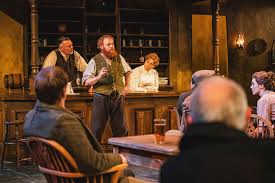
Still, Simon Holland Roberts almost carries the show with the energy and physicality he brings to Red Rogue Jones. He is here, there and everywhere, disappearing and then reappearing when you least expect it, filling the auditorium with his booming declarations, his self-justifications and his jokes. I thought he might fit in something by Sean O’Casey.
And although the other people in the play really just come and go – we never find out what made the estate owner’s beautiful daughter fall in love with Jones’ poor son or why the landlord stayed with his unfaithful wife – the cast do their bit, with outbursts of anger, lively arguments and prolonged kisses, right from the start when everyone sings in the pub.
The story of John Johns, the arc of the play, is a series of escapades followed by periods of incarceration. The details of these are often exaggerated but that’s acceptable. The one thing we do see him do is haul a gigantic cauldron into the pub and although he hasn’t been to Ireland to get it, it symbolises his ambition and his energy.
The cauldron also links to the First World War in a poetic way, since it is rumoured to have the power to bring dead men back to life. It’s certainly large enough to fill with corpses and its metallic presence makes you think of armoured vehicles.
The trouble is the play is not set up to prefigure the conflict that will probably carry off the young men we see. It’s not about that. It’s about several different things – the indomitable Welsh spirit (perhaps), the value of storytelling and fibbing and the strength of relationships (love triumphs over everything) – but the various themes get out of hand, as does Jones himself. In the end, there is only one way to bring it all to a close but the ending is not really in keeping with the overall tone.
I enjoyed the subplot of the oversized badger (a kind of animal representation of Jones) even if it didn’t advance the main story much. The beating of the sack the badger is meant to be in looked like the struggle the playwright was having to bring all the material he had collected so assiduously – folk stories, local legends and the like – under control.
In Wales, this production will do well. It would be interesting to see if it survived a tour elsewhere in the UK, where an audience would not be partisan. For all its limitations, it’s of a professional standard and it makes you look forward to the next play Chris Ashworth-Bennion writes – and that Theatr Clwyd puts on.