
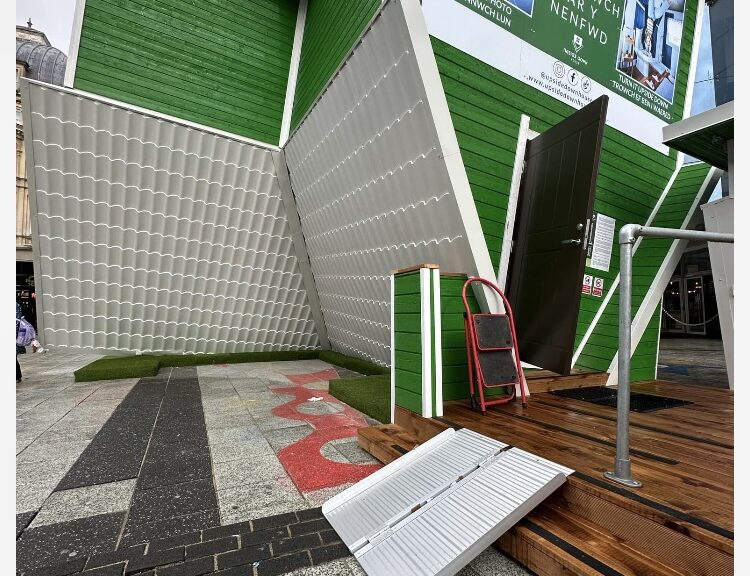
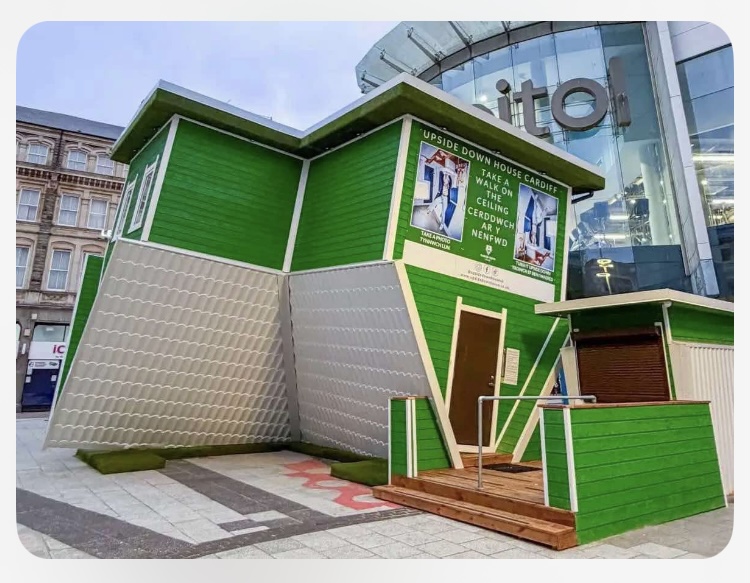
A new attraction opened in Cardiff recently, the Upside Down House.
The irony is hard to ignore. An Upside Down House , a playful, gravity-defying tourist attraction designed to surprise and delight. Turns out to be firmly grounded in one of society’s oldest failures: inaccessibility.
For wheelchair users, the disappointment isn’t about novelty or illusion. It’s about exclusion.
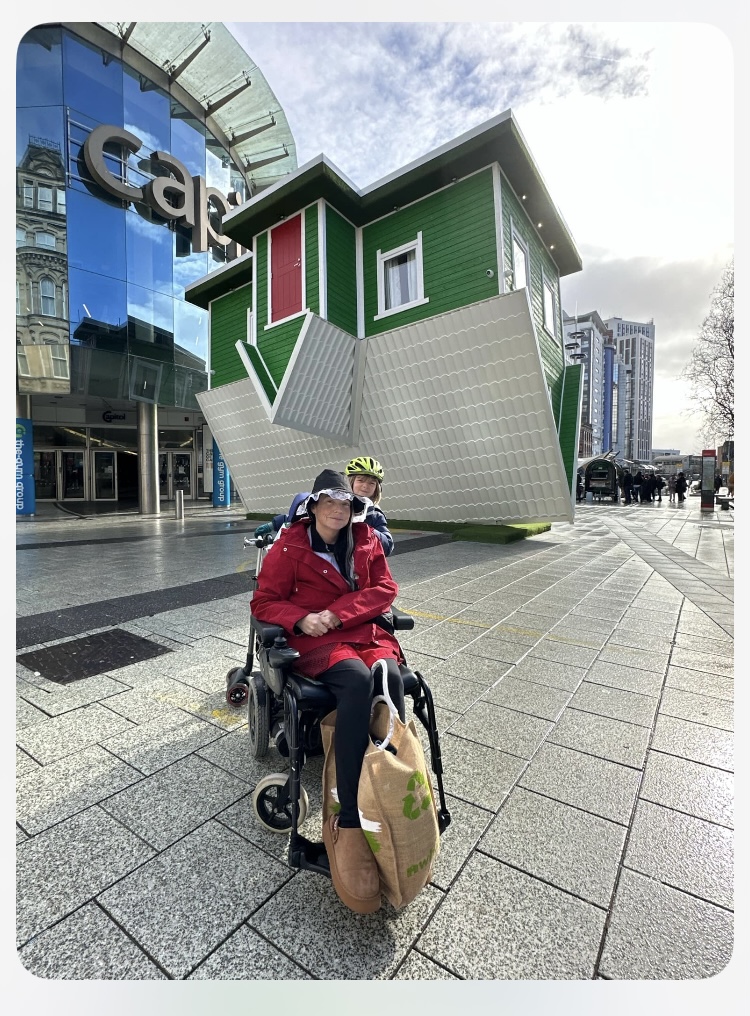
A Missed Opportunity at Ground Level.
No one reasonably expects every quirky feature of an attraction like this to be fully accessible. Tilted rooms and slanted floors present obvious design challenges. But what is far harder to understand is why even the ground floor, the one part that could have been designed with level access, remains inaccessible.
A ramp.
A flush threshold.
Wider doorways.
Thoughtful circulation space.
These are not radical architectural experiments. They are standard, achievable, and widely understood solutions.
When even the most basic entry is impossible, the message feels clear: accessibility was not part of the original plan.
The Bigger Issue: Accessibility as an Afterthought
The Upside Down House may be a novelty, but the exclusion it represents is painfully ordinary.
Wheelchair users encounter this pattern everywhere:
- Homes built with steps but no ramps
- Restaurants with narrow doorways
- Shops with raised thresholds
- Public buildings with token lifts that don’t work
- “Accessible” entrances hidden at the back
The real problem isn’t complexity. It’s priority.
Designers regularly account for aesthetics, branding, Instagram appeal, structural engineering, and crowd flow. Accessibility, too often, is treated as optional, something to “add later” if required by regulation.
And when it is added later, it’s usually compromised.
Inclusion Isn’t Incompatible with Creativity
Some might argue that the concept of an Upside Down House makes accessibility impossible. But creativity and inclusion are not mutually exclusive.
Designers could have:
- Built a fully level-access ground exhibition space
- Created virtual or interactive alternatives for upper floors
- Installed platform lifts where structurally feasible
- Designed at least one immersive room accessible to all visitors
Instead, the result reinforces a familiar reality: disabled people are expected to adapt, stay outside, or simply miss out.
A Reflection of the Housing Crisis
There is a deeper symbolism here.
The Upside Down House is meant to flip perspective, to make visitors see the world differently. Yet for wheelchair users, the world is already upside down.
In many countries, accessible housing is in short supply. New builds continue to prioritize minimum compliance rather than universal design. Retrofits are expensive and rare. Families are forced to move, adapt, or live in spaces that do not meet their needs.
When even a newly built tourist attraction cannot manage basic level access, it highlights the broader cultural issue: accessibility is still not seen as fundamental infrastructure.
The Emotional Cost of Inaccessibility
Disappointment in moments like this isn’t just logistical. It’s social.
It’s arriving excited, only to be told you can’t enter.
It’s watching friends go inside while you wait outside.
It’s being reminded again, that your participation was not considered.
Exclusion accumulates. Each inaccessible space reinforces the same quiet message: this world was not designed with you in mind.
Turning the World the Right Way Up
If attractions like this truly want to challenge perspectives, they could start by challenging their own design assumptions.
Accessibility should not be extraordinary.
It should not be expensive symbolism.
It should not be an afterthought.
It should be the baseline.
An Upside Down House is meant to be a playful illusion. But when it excludes wheelchair users entirely, even at ground level, it stops being whimsical and becomes a symbol of a much larger, very real problem.
Perhaps the real perspective shift we need isn’t architectural at all.
It’s cultural.
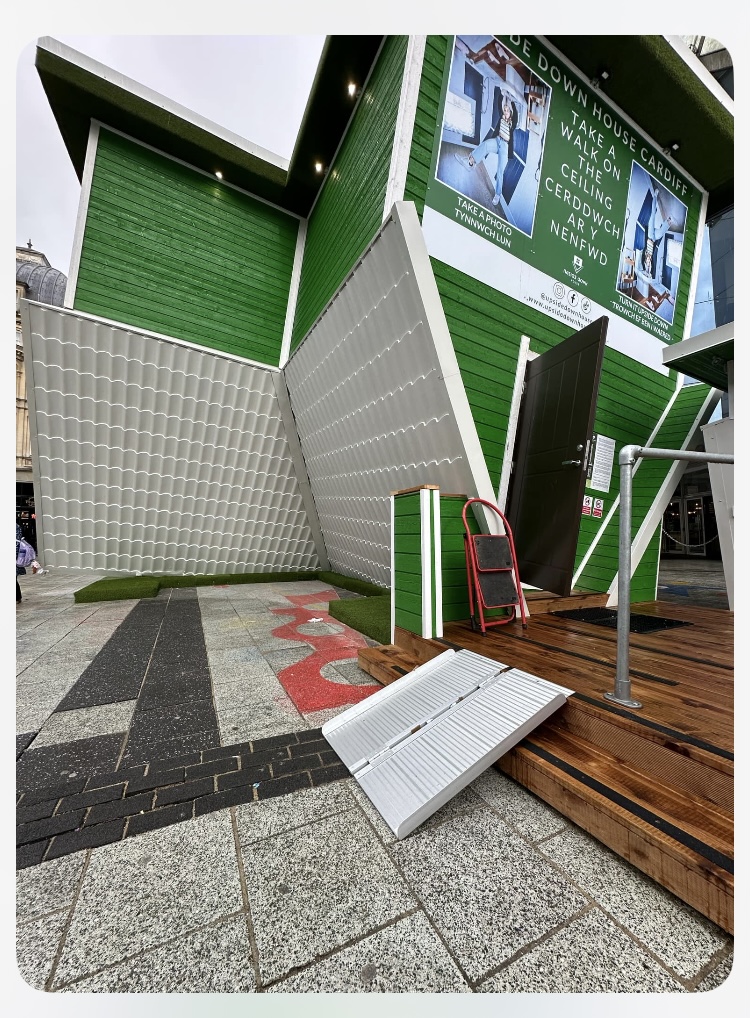
In addition, since writing this article, I reached out to the Upside Down House team, specifically the Cardiff venue to discuss wheelchair accessibility to at least part of the attraction.
I visited over the weekend and they unpackaged a new ramp. This was a positive first step. Unfortunately, the ramp was too unsafe to use due to its short length and the height required to get over the steps. The risk of tipping and falling was extremely high.
I have contacted their team again online to suggest a longer ramp, which would allow for a more gradual incline and provide safer access to the ground floor of the Upside Down House.
Baroness Grey-Thompson contacted me to commend me for reaching out to the company. She also agreed that the current ramp is unsafe and said she wouldn’t attempt to use it herself, despite being highly skilled and confident in her wheelchair, or even with someone supporting from behind.
I also asked, both by message and in person, whether there could be a reduction in ticket prices. If we were able to enter using a safe ramp, we still wouldn’t be able to experience the entire attraction. They told me that I could enter for free and that carers would receive a 10% discount. This would be helpful if they were able to advertise this information more clearly as well.
I’m hopeful that we can keep the lines of communication open and continue working together to make the attraction at least partly accessible for wheelchair users.
Ideally, accessibility should be considered from the very beginning, with research and consultation with disabled people taking place before attractions are designed and built. When accessibility is included at the planning stage, it is usually much easier to create experiences that more people can enjoy.
Additionally the company have contacted me to say, “Please be advised a new ramp has been ordered, which we hope will offer easier access. Once it is delivered to the House and we ensure that it is a better fit, we will be in touch again to invite you to visit the House. Thanks again for your feedback.”
I appreciate the actions of the organisation to support access to their attraction.